
Petrol Price in Pakistan Today – Latest Rates and Updates
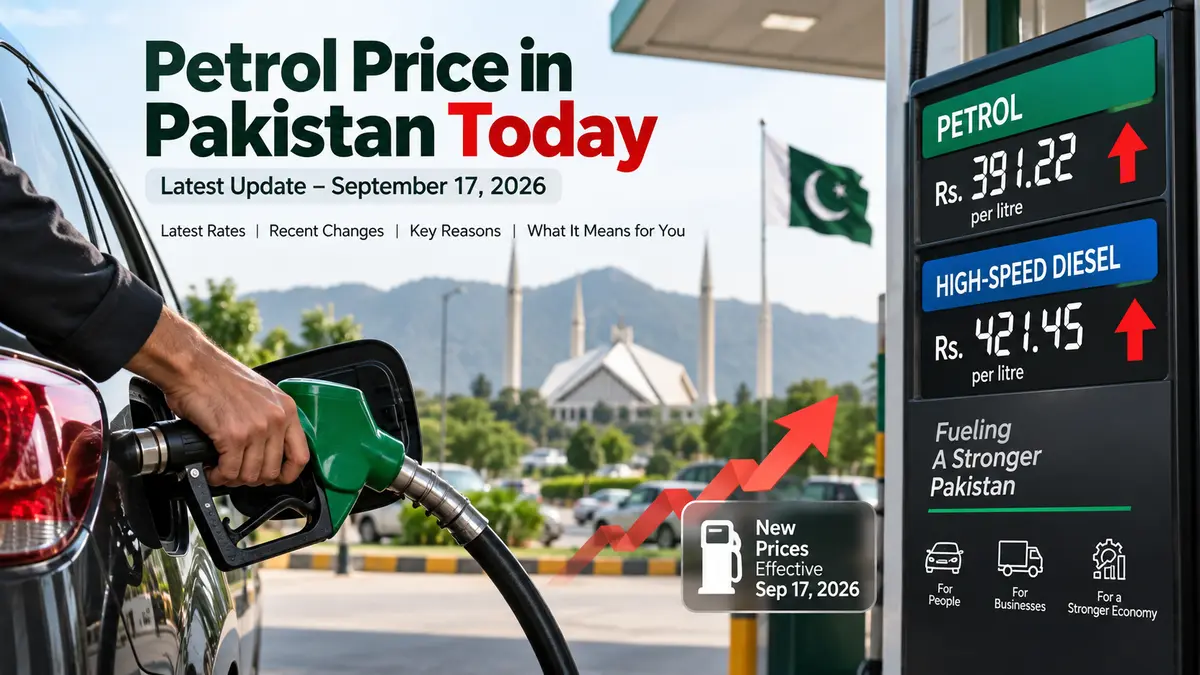
The petrol price in Pakistan today has increased again. Effective September 17, 2026, petrol is priced at Rs 391.22 per litre, while high-speed diesel (HSD) has reached Rs 421.45 per litre. Petrol increased by Rs 6.88 per litre from the previous day, while diesel increased by Rs 5.62.
Quick answer: As of September 17, 2026, the latest petrol price in Pakistan is Rs 391.22 per litre. High-speed diesel costs Rs 421.45 per litre. The latest revision raised petrol by Rs 6.88 and diesel by Rs 5.62 per litre, mainly due to higher international petroleum prices.
Latest Petrol and Diesel Prices in Pakistan
The latest revision has pushed both major petroleum products higher. The increase is important for Pakistani households because petrol is widely used by motorcycles and cars, while high-speed diesel has a larger impact on commercial transport, agriculture and the movement of goods.
The latest OGRA petroleum price revision has increased the cost of both major transport fuels.
| Petroleum Product | Previous Price | New Price | Change |
|---|---|---|---|
| Petrol | Rs 384.34/litre | Rs 391.22/litre | +Rs 6.88 |
| High-Speed Diesel (HSD) | Rs 415.83/litre | Rs 421.45/litre | +Rs 5.62 |
The new rates apply for Thursday, September 17, 2026.
What Changed on September 17, 2026?
Petrol has moved from Rs 384.34 to Rs 391.22 per litre, meaning a motorist now pays Rs 6.88 more for every litre purchased.
High-speed diesel increased from Rs 415.83 to Rs 421.45 per litre, adding Rs5.62 to each litre.
For an ordinary consumer, a few rupees per litre may appear manageable in isolation. However, when fuel prices rise repeatedly over several days, the effect becomes much larger.
For example, filling 40 litres of petrol at the new rate costs approximately Rs 15,648.80. At the previous Rs384.34 rate, the same quantity cost Rs15,373.60. That means an additional cost of roughly Rs 275.20 on a 40-litre fill after only the latest revision.
For businesses using diesel-powered transport, the impact can be greater because commercial vehicles consume much larger quantities.

Also read: Best Fuel Average Cars in Pakistan – The Ultimate Guide
Recent Petrol Price Changes in Pakistan
Fuel prices have moved sharply during September. Pakistan’s current pricing mechanism allows more frequent adjustments in response to international market movements.
| Effective Date | Petrol Price | HSD Price | Petrol Change | HSD Change |
|---|---|---|---|---|
| September 10 | Rs 367.75 | Rs 392.67 | +Rs 3.40 | +Rs 6.72 |
| September 11 | Rs 370.80 | Rs 398.04 | +Rs 3.05 | +Rs 5.37 |
| September 12–14 | Rs 375.82 | Rs 403.32 | +Rs 5.02 | +Rs 5.28 |
| September 15 | Rs 380.24 | Rs 409.42 | +Rs 4.42 | +Rs 6.10 |
| September 16 | Rs 384.34 | Rs 415.83 | +Rs 4.10 | +Rs 6.41 |
| September 17 | Rs 391.22 | Rs 421.45 | +Rs 6.88 | +Rs 5.62 |
The figures above are based on government-notified revisions reported between September 10 and September 17.
Between September 10 and September 17 alone, petrol rose from Rs 367.75 to Rs391.22, an increase of Rs 23.47 per litre. Over the same period, HSD increased by Rs 28.78 per litre, from Rs 392.67 to Rs 421.45.
Also read: 10 Easy Ways to Increase Your Fuel Mileage
Why Are Petrol Prices Increasing in Pakistan?
The latest increase has been linked primarily to higher international petrol and diesel prices. OGRA said the revision reflects international market rates, premiums and other relevant pricing factors.
Pakistan imports a significant share of its petroleum requirements, which means changes in international oil and refined-product markets can quickly affect domestic costs.
International Oil Market Volatility
Global energy markets have remained volatile because of continuing tensions and disruption risks in the Middle East.
When international petrol, diesel or crude prices rise, Pakistan’s import costs also come under pressure. Even when the global crude benchmark does not move sharply on a particular day, changes in refined-product prices, freight, premiums and supply conditions can affect local rates.
Supply Routes Matter
Disruption or uncertainty around major energy routes can increase the cost of oil transportation and imported petroleum products.
Recent regional tensions have affected important supply routes in the Middle East, adding uncertainty to energy markets.
Taxes and Duties Also Affect the Pump Price
International prices are not the only part of the final amount paid by consumers.
As of the latest revision, the government continues to collect around Rs114 per litre in taxes and duties on petrol and Rs100 per litre on high-speed diesel, according to reporting based on the Petroleum Division’s pricing information.
Therefore, the pump price includes both the underlying fuel cost and government charges.
How Pakistan’s Daily Fuel Pricing System Works
Pakistan moved toward a more frequent fuel-price review system in July 2026 as international energy markets became more volatile.
Under the current mechanism, OGRA can issue updated ex-depot rates based on international market conditions. The framework uses an average of recent international prices rather than depending only on a single day’s crude-oil movement.
OGRA has also started publishing fuel-pricing and Platts-related information online. Its September 2026 publications show frequent price data and petroleum-market updates.
One important point for consumers is that “daily pricing” does not necessarily mean a completely new price every calendar day. Under the framework reported by Geo News, rates notified on Fridays remain unchanged through Saturday and Sunday.
That explains why the Rs375.82 petrol and Rs403.32 diesel rates applied from September 12 through September 14 before another revision took effect on September 15.
How the Petrol Price Increase Affects Pakistani Households
Higher petrol prices directly affect millions of commuters, particularly people who travel daily by motorcycle or small car.
A motorcycle may use less petrol than a car, but frequent commuting means even smaller increases can accumulate over a month. A person using 30 litres monthly would pay around Rs11,736.60 at the September 17 petrol rate.
Households can also feel the indirect impact. When transporters and businesses face higher fuel expenses, part of that additional cost may eventually appear in the prices of goods and services.
Why High-Speed Diesel Prices Matter So Much
High-speed diesel is particularly important to Pakistan’s economy because it is used extensively in commercial transport and agricultural activity.
Higher diesel prices can raise the operating costs of trucks that move vegetables, flour, construction materials, imported goods and other products between cities.
Farmers may also face higher costs where diesel is used for tractors, machinery or other agricultural operations.
For this reason, HSD price movements can have a wider impact than the amount paid directly by motorists at fuel stations.
Could Higher Fuel Prices Add to Inflation?
Fuel prices can contribute to inflation because transportation is part of the cost of delivering almost every physical product.
Pakistan’s Sensitive Price Indicator had already shown upward pressure from energy prices. For the week ending September 10, the SPI was reported 8.62% higher year-on-year, with petrol and diesel among the items contributing to the increase.
However, fuel is only one inflation factor. Food supply, electricity prices, exchange rates, taxes, imports and domestic demand can also influence overall inflation.
Consumers should therefore avoid assuming that every increase in food or retail prices is caused only by petrol.
Petrol Relief Scheme for Motorcycles and Small Vehicles
The federal government has also announced a targeted petrol relief programme for selected small vehicles as fuel costs rise.
Under the announced scheme, eligible users receive Rs100 per litre in relief within a limited monthly quota. Two- and three-wheelers, including motorcycles, rickshaws and Qingqis, are eligible for relief on up to 20 litres per month. Cars with engines of up to 800cc are eligible for up to 30 litres per month.
The government said the scheme would expand across Pakistan, including Azad Jammu and Kashmir and Gilgit-Baltistan, from September 17.
Registration and practical availability should still be checked through official channels because implementation at individual filling stations can change.
How Eligible Consumers Can Use the Fuel Relief Scheme
According to the government’s announced procedure, vehicle details are verified through linked official records.
Users were instructed to register using their own mobile number and vehicle information. Once registration is confirmed, an eligible user can request a fuel token before visiting a participating filling station.
The announced process uses 9771 for the fuel-token system.
Consumers should use only official instructions and avoid sharing CNIC, verification codes or personal information with unofficial social-media pages or individuals claiming to offer registration assistance.
What Should Motorists Do When Prices Change Frequently?
Frequent revisions make monthly fuel budgeting more difficult, particularly for workers and businesses with fixed travel requirements.
A practical approach is to track actual litres used each week rather than estimating spending only in rupees. This makes it easier to understand whether a higher monthly fuel bill is coming from increased travel or an increase in the per-litre price.
Consumers can also reduce unnecessary fuel use by keeping tyres properly inflated, avoiding aggressive acceleration, combining short trips where practical and keeping vehicles maintained.
For businesses, delivery route planning and combining shipments may help reduce avoidable fuel consumption.
These steps cannot remove the effect of national fuel-price increases, but they can help households and businesses manage consumption.
Petrol vs Diesel Price in Pakistan
Petrol and HSD serve different parts of the market, which is why their economic effects differ.
| Factor | Petrol | High-Speed Diesel |
|---|---|---|
| Latest price | Rs 391.22/litre | Rs 421.45/litre |
| Latest increase | Rs 6.88 | Rs 5.62 |
| Common users | Motorcycles, cars | Trucks, buses, commercial vehicles, agriculture |
| Direct household impact | High | Moderate for many households |
| Transport/business impact | Significant | Very high |
| Current price level | Lower than HSD | Higher than petrol |
For an ordinary motorist, petrol is usually the more visible expense. For the wider economy, diesel can have a stronger effect through freight and commercial transport.
Will Petrol Prices Go Down Again?
Fuel prices can fall if international petrol and crude-oil markets ease, supply routes become more stable, import premiums decline or other pricing components move favourably.
However, the direction of the next revision cannot be known with certainty in advance.
Under a frequent pricing mechanism, both increases and decreases can theoretically be passed through more quickly.
Pakistani consumers should therefore rely on the latest official or regulator-backed notification instead of social-media predictions about the next petrol price.
Practical Tips for Checking the Latest Petrol Price
Because fuel prices are changing frequently, consumers should confirm the effective date whenever they see a rate online.
A price posted only one or two days earlier may already be outdated.
For reliable information, check OGRA’s fuel-pricing publications, Petroleum Division notifications, or established Pakistani news organisations that quote the latest official notification.
Also pay attention to whether a reported rate is an ex-depot price or an actual pump-specific rate, because location and marketing-company pricing information may need separate verification.
Frequently Asked Questions
What is the petrol price in Pakistan today?
The petrol price in Pakistan is Rs391.22 per litre, effective September 17, 2026. It increased by Rs6.88 from the previous Rs384.34 rate.
What is the diesel price in Pakistan today?
High-speed diesel is priced at Rs421.45 per litre as of September 17, 2026. The latest increase is Rs5.62 per litre.
When did the latest petrol price increase take effect?
The latest rates took effect on Thursday, September 17, 2026.
How much did petrol increase on September 17?
Petrol increased by Rs6.88 per litre, from Rs384.34 to Rs391.22.
How much did diesel increase?
High-speed diesel increased by Rs5.62 per litre, from Rs415.83 to Rs421.45.
Why is petrol getting expensive in Pakistan?
The latest increase has mainly been linked to higher international petroleum-product prices and volatility in global energy markets. Domestic taxes, duties, premiums and other pricing components also affect the final price.
Are petrol prices now revised every day?
Pakistan is operating a daily-review pricing mechanism, although this does not necessarily produce a new price every calendar day. Under the reported framework, Friday’s notified rates remain in place over Saturday and Sunday.
Is there any petrol subsidy in Pakistan?
A targeted scheme has been announced for motorcycles, rickshaws, Qingqis, other two- and three-wheelers, and cars up to 800cc. The scheme provides Rs100 per litre relief within defined monthly fuel limits for eligible registered users.
What is the monthly petrol-relief limit for motorcycles?
Eligible two- and three-wheelers have been allocated relief on up to 20 litres per month under the announced scheme.
What is the limit for cars up to 800cc?
Eligible vehicles with engines of up to 800cc can receive the announced relief on up to 30 litres per month.
Conclusion
The petrol price in Pakistan today is Rs391.22 per litre, while high-speed diesel has reached Rs421.45 per litre, effective September 17, 2026.
The latest adjustment represents an increase of Rs6.88 for petrol and Rs5.62 for HSD compared with September 16. It continues a sharp series of increases seen during September as Pakistan responds to volatile international petroleum markets.
For Pakistani households, commuters and businesses, the key issue is no longer only the size of one individual price increase. Frequent revisions can quickly change monthly transport expenses and business costs.
Consumers should therefore check the effective date of every fuel-price update, follow official pricing information, and use the government’s targeted fuel-relief programme if they meet the eligibility conditions.
This article reflects the fuel rates effective September 17, 2026 and should be updated again when the next official petroleum-price revision is announced.
Also check: LPG Price in Pakistan Today