
CM Punjab Solar Panel Scheme: New Updates 2026
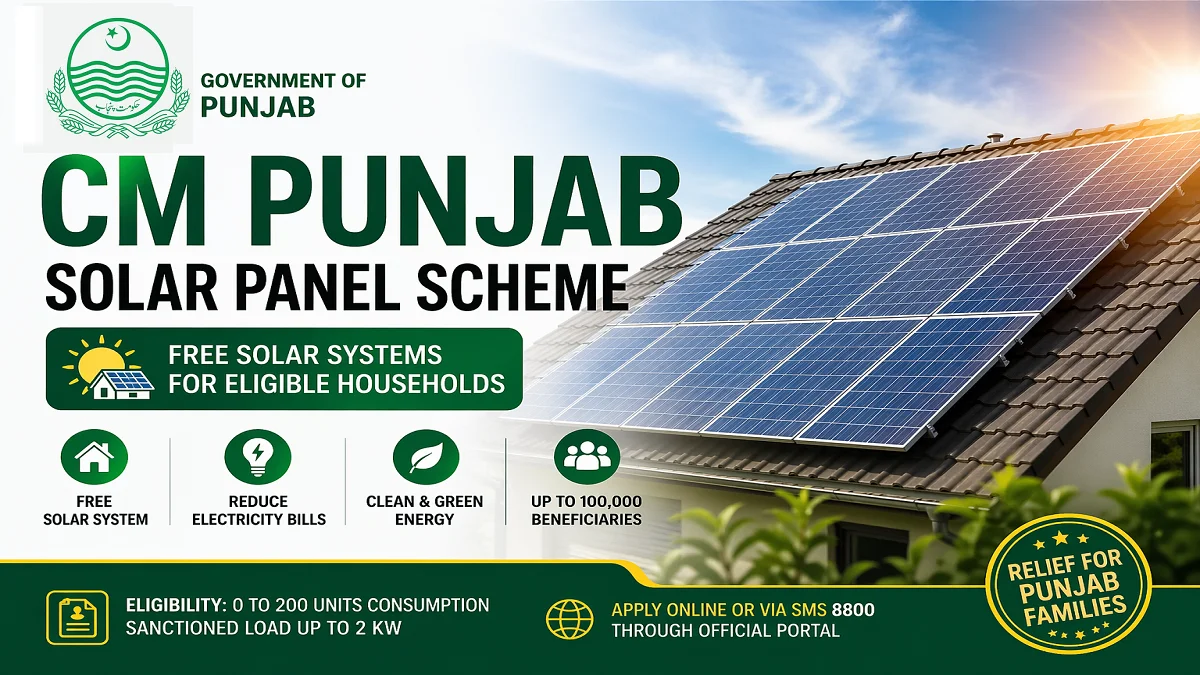
The CM Punjab solar panel scheme is one of the most important household energy relief programs launched by the Punjab government for low-consumption domestic electricity users. Its core purpose is simple: help eligible families reduce electricity bills by providing free solar systems, while also promoting cleaner energy use across the province. Official government information states that the scheme covers up to 100,000 free solar systems for eligible households in Punjab that fall within the 0 to 200 units monthly consumption range.
For many households, rising electricity costs have made monthly budgeting harder than ever. That is why the CM Punjab solar panel scheme has drawn strong public interest. The registration process, eligibility screening, digital balloting, and phased installation model were designed to target lower-usage domestic consumers rather than large commercial or high-load users. Government and public reporting also show that more than 861,000 applications were received, which highlights both the scale of demand and the need for a transparent selection process.
This guide explains what the scheme is, who qualifies, how the process works, what kind of solar system successful applicants receive, what the latest public updates show, and what households should understand before relying on the program.
What is the CM Punjab Solar Panel Scheme?
The CM Punjab solar panel scheme is a provincial government initiative aimed at giving free standalone solar systems to selected domestic electricity consumers in Punjab. According to official scheme pages, the program targets poor and lower-consumption households using between 0 and 200 units of electricity per month.

The broader policy goals behind the scheme include:
- reducing electricity bills for low-consumption households
- lowering reliance on conventional grid electricity
- encouraging renewable energy adoption
- easing pressure related to power subsidies
- supporting environmental goals through lower emissions
Public reporting around the launch also noted that the government expected the program to reduce carbon emissions by about 57,000 tonnes once the targeted installations were completed.
👉 Source: CM Punjab Solar Scheme Official Portal
Key Features of CM Punjab Solar Panel Scheme 2026
The official program framework and related government reporting show several important details that define the current understanding of the scheme:
| Scheme Detail | Current Publicly Reported Position |
|---|---|
| Type of support | Free solar systems for selected domestic consumers |
| Province | Punjab |
| Target consumption | 0 to 200 units per month |
| Maximum targeted systems | Up to 100,000 |
| First-phase reported installations | 94,483 systems |
| System categories publicly reported | 0.55 kW and 1.1 kW |
| Registration methods | Official online portal and SMS |
| SMS short code | 8800 |
| Selection method | Digital or computerized balloting |
| Consumer verification | Bill reference number and CNIC |
| Load limit | Up to 2 kW sanctioned load |
These details are reflected across official government summaries and supported by multiple public reports covering the launch, eligibility rules, and rollout.
Who Is Eligible for the CM Punjab Solar Panel Scheme?
Eligibility is one of the most searched aspects of the CM Punjab solar panel scheme because many households assume that low usage alone is enough. In reality, the program uses several filters.
Official and widely cited eligibility points indicate that an applicant should generally meet these conditions:
- be a domestic electricity consumer in Punjab
- have monthly electricity consumption from 0 to 200 units
- have a sanctioned load of up to 2 kW
- register through the official scheme portal or approved SMS method
- pass verification through the electricity bill reference number and CNIC
Official search results also indicate that the consumer categories covered include lifeline, protected, and non-protected users within the 0 to 200 unit range. Public reporting further states that eligibility was assessed using the bill for June 2024, which is an important detail because it means the scheme used a fixed billing reference period rather than a casual self-declared usage claim.
Reported Eligible Usage Categories
Public summaries of the scheme list these consumption segments:
- up to 50 units
- 51 to 100 units
- 0 to 100 units protected
- 0 to 100 units non-protected
- 101 to 200 units protected
- 101 to 200 units non-protected
This matters because the CM Punjab solar panel scheme was not framed only for one narrow billing slab. It appears to cover multiple domestic billing categories within the 0 to 200 unit range, as long as other scheme conditions are also satisfied.
Who Is Not Eligible?
This part is just as important as the eligibility list. Official and public reporting consistently point to the following exclusions:
- consumers involved in electricity theft
- consumers with defective meters
- households with multiple meters at a single residence
- domestic consumers with more than three late payments in the past 12 months
These exclusions show that the program is not only income- or usage-focused. It also checks billing discipline and meter integrity. That makes sense from a governance perspective because the government is trying to support compliant, traceable domestic users rather than users with unresolved meter or payment issues.
Required Documents for CM Punjab Solar Panel Scheme
One weakness in many online explanations of the CM Punjab solar panel scheme is that they talk about eligibility but skip the practical paperwork side. Based on the official scheme summaries and supporting reporting, applicants generally needed the following core details or documents:
- Valid CNIC
- Electricity bill reference number
- Domestic consumer information matching the bill
- Mobile number for registration and status communication
The official scheme summaries and related reporting repeatedly mention that registration and verification were done using the reference number and CNIC number mentioned on the consumer’s electricity bill. That strongly supports the conclusion that these were the essential pieces of information for a valid application.
How to Apply for CM Punjab Solar Panel Scheme
The application process is one of the highest-intent search areas for this topic. Publicly available official summaries and public reporting show that the scheme allowed two main application methods: online registration through the official portal and SMS registration through 8800.
Method 1: Apply Through the Official Portal
Applicants could apply through the dedicated scheme website. The process, as described in public reporting, followed a straightforward structure:
- Visit the official CM Punjab solar panel scheme portal.
- Register or log in on the portal.
- Enter your electricity bill reference number.
- Review the domestic consumer information shown by the system.
- Check whether the details match your bill and CNIC-linked record.
- Submit the application.
- Wait for screening, verification, and balloting.
Method 2: Apply Through SMS
The SMS method was especially useful for users with limited internet access. Publicly reported instructions say that eligible consumers could register by sending their bill reference number and CNIC to 8800.
A simple SMS-based version of the process looked like this:
- Open the SMS app on your phone.
- Type your bill reference number and CNIC number in the required format.
- Send the message to 8800.
- Wait for confirmation or further processing updates.
What Happens After You Apply?
Submitting an application was not the final step. Public reporting indicates that the scheme moved through multiple stages after registration:
- initial eligibility screening
- verification through bill reference number and CNIC
- digital balloting for registered eligible consumers
- physical verification of selected consumers
- installation of the solar system
This is important because many users assume that submitting the form means automatic approval. The scheme actually depended on verification and selection after application.
Was There a Registration Deadline?
Yes. Public Punjab government reporting stated that January 5, 2025 was the last date for registration under the announced phase. This is a critical detail because many users still search the topic as if general open registration is permanently available. The available government reporting reviewed here confirms that the original application window had a clear deadline.
That means anyone searching now for cm punjab solar panel scheme apply online should first verify whether a fresh registration phase has officially reopened. The scheme portal remains an important reference point, but users should not assume that every earlier application instruction still means the scheme is open for new entries at all times.
What Solar System Will Selected Applicants Receive?
Public reporting around the first phase states that the scheme included two main solar system sizes:
- 0.55 kW solar systems
- 1.1 kW solar systems
More specifically, reports stated that the first phase included:
- 47,182 systems of 0.55 kW
- 47,301 systems of 1.1 kW
Another reported breakdown explained the intended allocation in practical consumption terms:
- consumers using up to 100 units per month would get 550-watt systems
- consumers using up to 200 units per month would get 1,100-watt systems
Simple System Comparison
| Consumption Bracket | Publicly Reported System Size |
|---|---|
| Up to 100 units | 550 watts |
| Up to 200 units | 1100 watts |
This size distinction helps explain how the CM Punjab solar panel scheme was tailored to lower-usage households rather than medium- or high-load users.
How Were Beneficiaries Selected?
Because the number of applicants was far higher than the number of available systems, the Punjab government used digital balloting. Public reports describe the process as computerized and end-to-end digitized. This is a key credibility point because it suggests the government tried to avoid manual favoritism by using a structured electronic selection method after eligibility screening.
Why Balloting Was Necessary
The numbers make the reason clear.
| Item | Publicly Reported Figure |
|---|---|
| Applications received | More than 861,000 |
| Target free systems | Up to 100,000 |
| First phase installations | 94,483 |
With such a large gap between applications and available systems, balloting was unavoidable. Even households that appeared eligible on paper were not guaranteed immediate selection.
Main Benefits of the CM Punjab Solar Panel Scheme
The strong interest in the CM Punjab solar panel scheme is easy to understand because the program offers several direct benefits.
Lower monthly electricity costs
The most obvious benefit is reduced dependence on the grid for selected households, which can lower the electricity bill burden. Official and public descriptions repeatedly frame household relief as a central objective.
Free access to solar for low-consumption households
Private solar installations require upfront investment, which many households cannot afford. This scheme removes that initial cost for selected beneficiaries.
Better energy security
Even a smaller solar setup can improve daytime electricity availability and help households reduce pressure from rising tariffs.
Support for cleaner energy
The scheme also supports renewable energy adoption at the household level, which is one of its broader policy aims.
Practical Tips Before You Rely on the Scheme
If you are writing for users or advising households about the CM Punjab solar panel scheme, these practical points matter:
Do not assume every low-bill household qualifies
Low monthly units are important, but sanctioned load, meter status, payment history, and reference-bill eligibility also matter.
Keep CNIC and bill details accurate
Because verification depends on CNIC and bill reference matching, even small data issues can create problems during screening.
Watch official announcements for new phases
Since earlier registration had a fixed deadline, households should rely on official Punjab government notices instead of random social media claims when checking whether a new application phase has opened.
Expect selection, not automatic approval
Registration enters the applicant into a process. It does not guarantee final installation because the scheme depends on verification and balloting.
CM Punjab Solar Panel Scheme vs Private Solar Installation
Some households compare the scheme with buying solar privately. That comparison helps users understand where the scheme fits.
| Point | CM Punjab Solar Panel Scheme | Private Solar Installation |
|---|---|---|
| Upfront cost | Free for selected users | Paid by homeowner |
| Eligibility rules | Strict | No scheme rules, only budget limits |
| Availability | Limited by phase and balloting | Depends on market and funds |
| Approval certainty | No | Yes, if the buyer proceeds |
| Target user | Low-consumption domestic consumer | Any suitable property owner |
For a qualifying low-consumption household, the CM Punjab solar panel scheme can be a major relief opportunity. For households that need faster installation or a larger system, private solar remains the more direct route.
FAQs about CM Punjab Solar Panel Scheme 2026
Q1: Who is eligible for the scheme?
Residents of Punjab with 200–300 unit monthly electricity usage, valid CNIC, and no prior solar subsidy.
Q2: How can I apply online?
Visit cmsolarscheme.punjab.gov.pk, enter CNIC + electricity bill number, upload documents, and submit.
Q3: What does the package include?
1–3 kW system with panels, inverter, mounting structure. Batteries only in special cases.
Q4: Are batteries included?
Mostly no. Only included in regions with extended load-shedding.
Q5: Can I reapply if rejected?
Yes, in the next phase, provided you still meet eligibility requirements.
Conclusion – CM Punjab Solar Panel Scheme 2026
The CM Punjab solar panel scheme is a targeted public relief and renewable energy initiative for domestic consumers in Punjab. Publicly available official summaries and supporting reporting show that it was designed for households consuming 0 to 200 units, with a sanctioned load of up to 2 kW, registration through the official portal or SMS to 8800, and verification through the bill reference number and CNIC. Required application details centered on identity and electricity-account verification, while the process moved from registration to screening, digital balloting, physical verification, and installation.
Also read: CM Solarization Program for Agri Tubewells: Apply Now!