
Pakistan Traffic Rules 2026: New Fines & Speed Limits
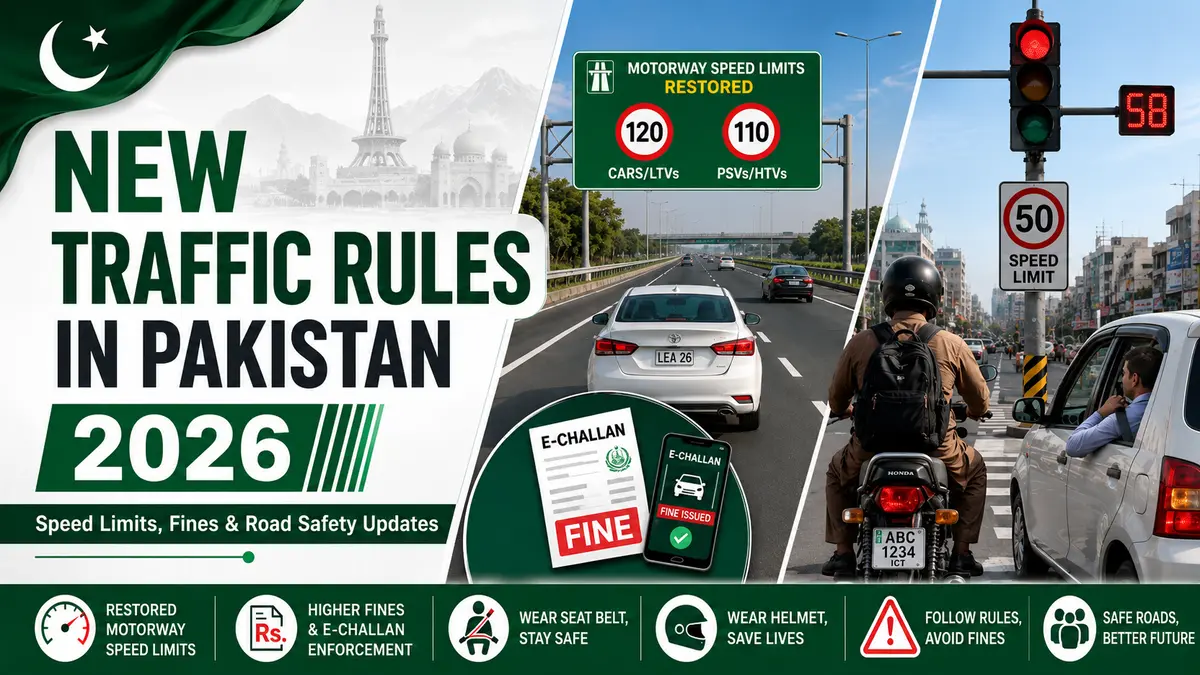
Pakistan traffic rules 2026 cover licensing, speed limits, helmet and seat-belt requirements, lane discipline, and province-wise fines — and several of these were updated this year after a short-lived fuel-conservation policy changed the numbers twice. If you drive on a motorway, a city road, or between provinces, knowing the current rule (not last year’s, and not the temporary one from earlier in 2026) can save you a heavy challan.
Quick answer: Pakistan’s motorway and highway speed limits were cut in March 2026 to save fuel, then restored in June 2026. Cars and light vehicles can now travel at 120 km/h on motorways and 100 km/h on national highways, while heavier and passenger vehicles follow slightly lower limits. licence, helmet, seat-belt, and phone-use rules remain enforced nationwide, with fines set separately by each province.
What Changed in Pakistan Traffic Rules in 2026
Two changes stand out in Pakistan traffic rules this year, and mixing them up is the most common reason drivers get confused about what’s actually legal right now.

The fuel-conservation speed cut (March 2026)
In late March 2026, the National Highways & Motorway Police (NHMP) lowered speed limits nationwide as part of a government fuel-saving push during a period of high global oil prices. Motorway limits for cars and light transport vehicles (LTVs) dropped from 120 km/h to 100 km/h, and national highway limits dropped from 100 km/h to 80 km/h, with matching cuts for passenger and heavy vehicles.
The restoration (June 2026)
By late June 2026, the government withdrew the temporary cut. The Motorway Police confirmed that limits reverted to their earlier levels: 120 km/h for cars and LTVs on motorways, 110 km/h for passenger and heavy vehicles on motorways, 100 km/h for cars and LTVs on national highways, and 80 km/h for heavier vehicles on national highways. If you saw a post online claiming motorway speeds are still capped at 100 km/h, that information is outdated — the restored limits have applied since late June 2026.
Beyond the speed-limit back-and-forth, most of 2026’s other developments are enforcement upgrades rather than brand-new laws: wider use of AI-enabled cameras, faster e-challan issuance, and stricter checks on documentation and fitness certificates for commercial vehicles. The underlying rules — licensing, helmets, seat belts, phone use, and lane discipline — have not changed in substance.
Core Pakistan Traffic Rules You Need to Know
1. Carry a Valid Driving licence and Vehicle Documents
You must hold a driving licence that matches the category of vehicle you’re operating (motorcycle, light vehicle, heavy vehicle, or public service vehicle). Provincial motor-vehicle laws treat driving without a valid licence as a serious offense, and it typically carries one of the heaviest fines on any province’s schedule.
Along with your licence, keep these on hand whenever you drive:
- Vehicle registration book or smart card
- Proof of paid token tax
- Fitness certificate and route permit (commercial and public-service vehicles only)
- Insurance documents, where applicable to your vehicle or loan agreement
Missing documentation is one of the most frequently issued tickets in Pakistan, simply because drivers assume having a car is enough — the paperwork matters just as much as the vehicle itself.
Also read:
- How to Get Your Punjab Driving Licence: The Ultimate Guide
- How to Get Permanent Driving Licence in Sindh (Step-by-step)
- International Driving Licence Pakistan: Valid Countries 2026
- How to Get Balochistan Driving Licence: The Ultimate Guide
- How to Get KPK Driving Licence: The Ultimate Guide 2026
2. Follow the Posted Speed Limit
Speed limits depend on the road type and vehicle category. Here’s how they currently stand after the June 2026 restoration:
| Road Type | Vehicle Type | Speed Limit |
|---|---|---|
| Motorways (M-1 to M-9) | Cars / LTVs | 120 km/h |
| Motorways (M-1 to M-9) | PSVs / HTVs | 110 km/h |
| National highways | Cars / LTVs | 100 km/h |
| National highways | PSVs / HTVs | 80 km/h |
| Urban arterial roads | All vehicles | 80 km/h |
| Urban residential & hilly areas | All vehicles | 50–70 km/h |
| Near schools, hospitals, mosques | All vehicles | 40 km/h |
Two exceptions matter more than the table itself. First, posted road signs always override the general limit — a specific stretch of motorway near a toll plaza, an accident-prone curve, or a construction zone can carry a lower limit than its category suggests, and that sign is what applies, not the table above. Second, fog, heavy rain, and dust storms regularly trigger temporary speed reductions or full closures on motorways, especially in Punjab during winter. Always check NHMP’s traffic advisories before a long-distance drive between November and February.
3. Follow Traffic Signals and Road Signs
Running a red light, ignoring a stop line, or driving the wrong way on a one-way street is a punishable offense under every province’s traffic schedule. Punjab, for instance, currently fines motorcycles around Rs. 2,000 and cars around Rs. 5,000 for signal violations — but treat this as an example rather than a nationwide figure, since Sindh and KP set their own amounts.
Also read: Traffic Signs Test in Pakistan 2026 – The Ultimate Guide
4. Maintain Lane Discipline and Overtake Correctly
Stay in your lane, signal before switching, and avoid unnecessary weaving through traffic. On motorways and highways, overtaking is meant to happen from the right-hand lane, which should be used for passing only — not as a default cruising lane.
This is one of the most commonly ticketed habits among otherwise careful drivers: sitting in the overtaking lane without actually overtaking anyone. If you’re not actively passing a vehicle, move back to the left lane. Motorway cameras increasingly flag this automatically.
5. Wear a Seat Belt — Front and Back
All drivers must wear a seat belt before the vehicle moves, and children should use a seat belt or an age-appropriate child restraint. Punjab’s offense schedule lists seat-belt violations on notified roads, with the fine varying by vehicle category. Increasingly, cities are extending enforcement to rear-seat passengers on motorways, so don’t assume the back seat is exempt just because checks have historically focused on the driver.
6. Wear a Helmet on a Motorcycle
Motorcyclists must wear a properly fastened crash helmet. In Punjab, riding without one currently carries a Rs. 2,000 fine. Islamabad has gone further: since July 2025, helmets have been mandatory for both the rider and the pillion (backseat) passenger within the capital. Other provinces enforce passenger-helmet rules less consistently, so don’t assume the same standard applies the moment you cross a provincial boundary.
7. Never Use a Handheld Phone While Driving
Using a handheld mobile phone while driving — for calls, texting, or navigation held in hand — is illegal nationwide. Punjab’s published penalty ranges from Rs. 2,000 to Rs. 15,000 depending on the vehicle type. Hands-free systems and Bluetooth are permitted, but the safest habit is to pull over before making a call or reading a message rather than relying on a mount while moving.
8. Respect Parking and One-Way Restrictions
Don’t drive against one-way traffic, and don’t park in a way that blocks other vehicles or ignores posted restrictions. Punjab currently lists parking fines between Rs. 2,000 and Rs. 15,000, again scaled by vehicle category.
Step-by-Step: What to Check Before Every Drive
- Confirm your licence and registration are current. An expired licence is treated the same as not having one in most provinces.
- Check the token tax status of your vehicle. Unpaid token tax is increasingly flagged during routine checks and ANPR camera scans.
- Inspect basic safety equipment. Seat belts working, mirrors intact, and a helmet on hand if you’re on a motorcycle.
- Look up the day’s road conditions. For long trips on the motorway, check NHMP’s advisory for fog, construction, or accident-related diversions before you leave.
- Fasten seat belts for every occupant, not just the driver. Do this before the vehicle starts moving.
- Put your phone on a hands-free setup or out of reach. If you need to check it, plan to stop rather than glance while driving.
- Review the posted speed limit as you enter a new road type. The limit changes as you move from motorway to highway to city street, and signage always takes priority over the general rule.
Traffic Rules and Fines by Province
The underlying rules are broadly the same across Pakistan, but each authority sets its own penalty amounts and runs its own enforcement system. Always check which authority issued your challan before assuming a fine amount applies.
Punjab
Traffic Police Punjab maintains its own offence and penalty schedule, which is currently the most detailed of any province. Example fines include Rs. 2,000 for riding without a helmet, Rs. 2,000 to Rs. 15,000 for using a handheld phone while driving, Rs. 2,000 to Rs. 15,000 for parking violations, and signal violations set at Rs. 2,000 for motorcycles and Rs. 5,000 for cars.
Sindh
Sindh Police enforces traffic violations through TRACS, its digital citation system. TRACS currently lists Rs. 25,000 for driving without a valid licence and Rs. 10,000 for exceeding the prescribed speed limit — both noticeably higher than Punjab’s equivalent fines, so drivers moving between the two provinces shouldn’t assume the numbers carry over.
Khyber Pakhtunkhwa
Peshawar Traffic Police publishes its own fine codes, but the current table is described as proposed rather than finalized. Treat any KP fine figure you see online as a reference point until a final province-wide notification confirms it.
Balochistan
Traffic enforcement in Balochistan continues under the general provincial motor-vehicle framework and applicable police regulations, without the kind of unified digital fine table that Punjab and Sindh have introduced.
Islamabad
Islamabad Traffic Police enforces rules separately within the federal capital. This is also the jurisdiction with the strictest helmet rule in the country — pillion passengers, not just riders, have been required to wear helmets since July 2025.
Motorways and National Highways
The NHMP applies its own rules and posted road restrictions uniformly across the motorway network, from M-1 through M-9, regardless of which province a given stretch of road passes through.
Right of Way and Intersection Rules
At an unmarked intersection with no signal or sign, traffic approaching from your right generally has priority. At a roundabout, vehicles already inside the circle have the right of way over vehicles entering it — a rule that’s frequently ignored in city driving but is one of the more commonly cited causes of intersection collisions.
What Happens If You Break a Traffic Rule
Most cities now issue challans digitally through camera-based systems (Safe City cameras in Punjab, TRACS in Sindh, and similar setups in Islamabad), which means you can receive a fine even if no officer physically stopped you. Challans are typically sent as an SMS or app notification and can be checked and paid online using your CNIC, vehicle registration number, or licence number, depending on the province’s portal. Unpaid challans can accumulate and, in some provinces, affect renewal of your registration or licence, so it’s worth clearing them promptly rather than letting them stack up.
Practical Tips Beyond the Basic Rules
- Don’t rely on last year’s fine amounts. Several provinces revised their schedules in 2026, and KP’s current figures are still marked as proposed rather than final — treat any number you see online as a starting reference, not a guarantee.
- Screenshot or save confirmation after paying a challan online, since portals occasionally show delayed status updates.
- If you drive between provinces regularly, keep a mental note of at least the helmet and phone-use rules for each, since these are the two most commonly enforced against out-of-province drivers.
- For commercial vehicles, check fitness certificate expiry separately from registration — the two lapse on different schedules, and driving with an expired fitness certificate is treated as a distinct violation from an expired registration.
FAQs About Pakistan Traffic Rules 2026
What is the current motorway speed limit in Pakistan in 2026?
After being temporarily reduced in March 2026 for fuel conservation, the limit was restored in June 2026 to 120 km/h for cars and LTVs, and 110 km/h for PSVs and HTVs, on motorways.
Is it mandatory to wear a helmet as a passenger in Pakistan?
It depends on the city. Islamabad has required helmets for both the rider and the pillion passenger since July 2025. Elsewhere, passenger-helmet rules vary by province and are enforced less consistently.
Can I use my phone while driving in Pakistan?
No. Using a handheld mobile phone while driving is illegal nationwide. Hands-free and Bluetooth systems are allowed.
Who has the right of way at an unmarked intersection?
Traffic approaching from your right generally has priority at an unmarked intersection, and vehicles already inside a roundabout have priority over those entering it.
What documents must I carry while driving in Pakistan?
A valid driving licence for your vehicle category, vehicle registration, proof of paid token tax, and — for commercial or public-service vehicles — a fitness certificate and route permit. Insurance documents apply where relevant to your vehicle or financing agreement.
Are the national highway speed limits the same as motorway limits?
No. National highways carry lower limits than motorways — currently 100 km/h for cars/LTVs and 80 km/h for PSVs/HTVs, compared to 120 km/h and 110 km/h on motorways.
Conclusion (Pakistan Traffic Rules 2026)
The headline change for Pakistan traffic rules 2026 is the speed-limit roller coaster: cut in March for fuel conservation, restored in June to the familiar 120 km/h motorway limit for cars. Everything else — licensing, helmets, seat belts, phone use, and lane discipline — has stayed largely the same, with enforcement getting stricter and more digital rather than the rules themselves changing. Before you drive, confirm your documents are valid, check the posted limit rather than assuming last year’s number still applies, and remember that fines differ by province even when the underlying rule doesn’t. Treating the rule as the point — not just the fine attached to it — is what actually keeps you and everyone else on the road safe.
Also read: E-Challan Punjab Check by Vehicle Number: The Ultimate Guide