
NADRA ACC & POR Card Cancellation: Guide to CNIC Restoration
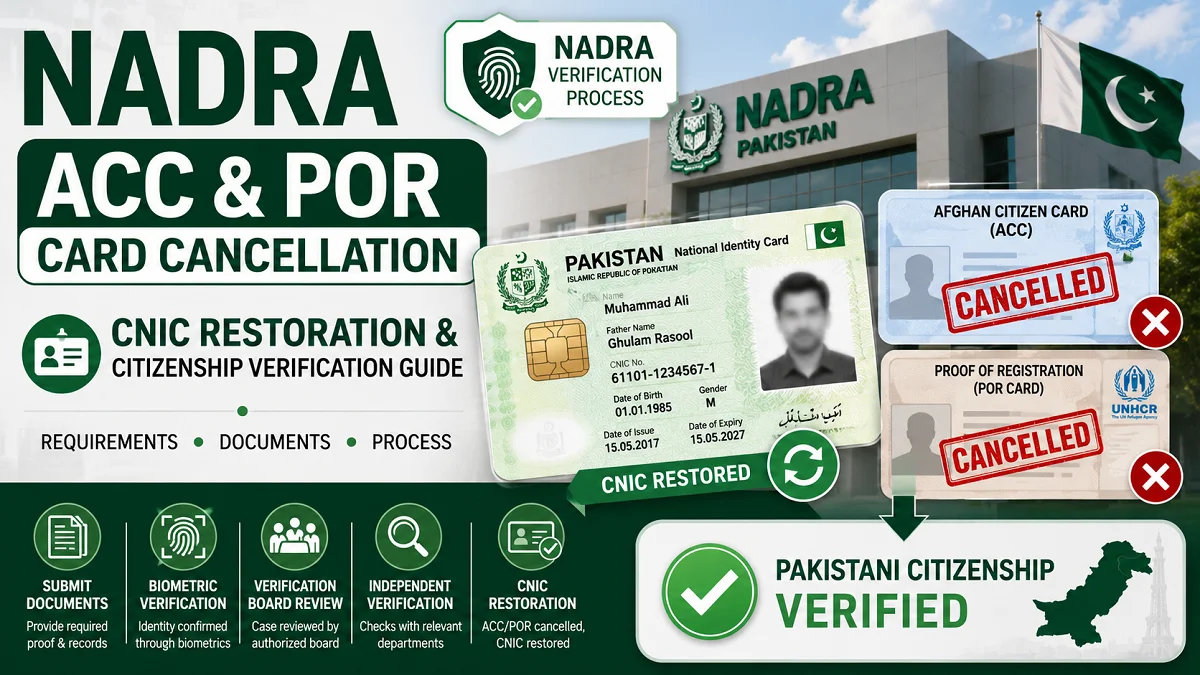
The Government of Pakistan has introduced a formal process for individuals who previously obtained an Afghan Citizen Card (ACC) or a Proof of Registration (POR) Card but claim Pakistani citizenship. Through the NADRA ACC & POR Card Cancellation procedure, eligible individuals can request verification of their Pakistani citizenship and seek the restoration of their National Identity Card (CNIC).
This development provides a legal pathway for affected citizens whose CNICs were canceled because they were recorded as holders of ACC or POR documentation. At the same time, the process strengthens identity management, improves record accuracy, and ensures that citizenship decisions are based on verifiable evidence.
In this guide, we explain how the NADRA ACC & POR Card Cancellation process works, who can apply, what documents are required, how verification takes place, and what applicants should expect throughout the procedure.
Understanding ACC and POR Cards
Before discussing the restoration process, it is important to understand the difference between ACC and POR cards.
What Is an Afghan Citizen Card (ACC)?
An Afghan Citizen Card is a document issued to certain Afghan nationals residing in Pakistan. The card serves as an identification document and helps authorities maintain records of Afghan citizens living within the country.
What Is a Proof of Registration (POR) Card?
A Proof of Registration Card is another document issued to registered Afghan refugees. It confirms registration status and allows authorities to identify and manage refugee records.
Why Do These Cards Affect Pakistani Citizenship Records?
When an individual obtains an ACC or POR card, authorities may determine that the person has identified themselves as a foreign national or refugee. In some cases, this can create conflicts with existing Pakistani citizenship records.
As a result, NADRA may suspend or cancel a CNIC until the individual’s citizenship status is fully verified.
What Is the NADRA ACC & POR Card Cancellation Process?
The NADRA ACC & POR Card Cancellation process is a legal mechanism that allows affected individuals to present evidence supporting their claim of Pakistani citizenship.
Under relevant provisions of Pakistan’s citizenship laws, NADRA and authorized government officials can review available evidence, conduct verification, and determine whether an applicant qualifies for recognition as a Pakistani citizen.
If citizenship is successfully established, the ACC or POR card may be canceled, and the applicant may become eligible for the restoration or reissuance of a Pakistani CNIC.
Who Can Apply?
This process generally applies to individuals who:
- Previously obtained an ACC card
- Previously obtained a POR card
- Had their CNIC canceled or blocked due to ACC or POR records
- Possess evidence supporting a claim of Pakistani citizenship
- Wish to restore their legal identity documents in Pakistan
Applicants must provide reliable documentation that demonstrates their citizenship claim.
Why Was This Procedure Introduced?
The government introduced this procedure to address situations where citizenship records require further examination.
Several factors contributed to the need for a structured review process:
| Reason | Explanation |
|---|---|
| Record Accuracy | Ensures national databases contain accurate information |
| Identity Verification | Confirms genuine citizenship claims |
| Legal Compliance | Aligns decisions with citizenship laws |
| Citizen Facilitation | Provides an opportunity for eligible individuals to restore their status |
| National Security | Helps prevent misuse of identity documents |
This approach balances citizen rights with regulatory requirements.
Legal Authority Behind the Process
The review mechanism operates under the framework of Pakistan’s citizenship laws and NADRA’s legal authority to maintain and verify identity records.
Authorities assess each case individually and make decisions based on:
- Documentary evidence
- Historical records
- Family lineage records
- Government-issued documents
- Verification from relevant departments
No case is automatically approved. Each application undergoes a detailed review process.
Required Documents for Citizenship Verification
One of the most important parts of the NADRA ACC & POR Card Cancellation process is submitting strong documentary evidence.
The quality and authenticity of documents can significantly affect the outcome of an application.
Common Supporting Documents
Applicants may provide documents such as:
- Government land records dated before 1979
- Local certificates issued before 1979
- Domicile certificates where applicable
- Old Pakistani passports
- Previous CNICs or identity documents
- Government employment records issued before 1990
- Verified family trees or genealogy records
- Educational records
- Birth records
- Other official documents demonstrating historical links to Pakistan
Importance of Historical Records
Older records often carry substantial evidentiary value because they help establish long-term residence, family history, and legal ties to Pakistan.
Documents from earlier decades may strengthen an applicant’s claim when they clearly demonstrate continuity of citizenship.
Affidavit Requirements
Applicants are generally required to submit a sworn affidavit verified by an authorized Oath Commissioner.
The affidavit should confirm that:
- The information provided is accurate
- The documents submitted are genuine
- The applicant is making truthful declarations
- No material facts have been concealed
False statements may result in legal consequences.
Step-by-Step NADRA ACC & POR Card Cancellation Process
Understanding the sequence of events can help applicants prepare more effectively.
Step 1: Gather Supporting Evidence
Applicants should collect all available documents supporting their citizenship claim.
The stronger the evidence, the easier it becomes for authorities to review the case.
Step 2: Prepare the Application
The application should include:
- Personal information
- Supporting documents
- Affidavit
- Identification records
- Any additional evidence requested by NADRA
Step 3: Visit the Designated NADRA Center
Applicants must appear at the designated NADRA office.
Officials may:
- Review submitted documents
- Capture biometric information
- Verify identity details
- Record necessary information
Step 4: Verification Board Review
After initial processing, applicants may be called before a special verification board.
This stage provides an opportunity to:
- Present the citizenship claim
- Explain supporting evidence
- Clarify inconsistencies
- Respond to official questions
Step 5: Independent Verification
NADRA may coordinate with:
- Government departments
- Record-keeping agencies
- Local authorities
- Historical record repositories
- Other relevant institutions
These checks help determine whether the submitted information is authentic.
Step 6: Final Decision
Once the review process is complete, authorities issue a decision based on available evidence and verification results.
If citizenship is established, the process can move toward NADRA ACC & POR card cancellation and restoration of Pakistani identity documents.
How Long Does Verification Take?
Processing times can vary depending on several factors.
These may include:
- Complexity of the case
- Number of documents submitted
- Availability of historical records
- Responses from government agencies
- Verification workload
Cases involving extensive documentation reviews may take longer than straightforward applications.
What Happens If Citizenship Is Confirmed?
When authorities determine that an applicant is a Pakistani citizen, several outcomes may follow.
Possible Benefits
- Cancellation of ACC or POR records
- Restoration of CNIC status
- Issuance of a new CNIC where applicable
- Reinstatement of identity records
- Access to services linked to valid identification documents
The final outcome depends on compliance with all legal requirements and successful verification.
Important Legal Considerations
Applicants should understand that approval of citizenship verification does not automatically eliminate potential legal liabilities.
Authorities may still take action under applicable laws if violations occurred in the past.
Therefore, applicants should approach the process with complete transparency.
Key Legal Points
| Consideration | Impact |
| False Information | May lead to legal action |
| Fake Documents | Can result in rejection and penalties |
| Concealed Facts | May negatively affect the case |
| Misrepresentation | Could trigger further investigation |
| Fraudulent Claims | May result in document cancellation |
Honesty and accuracy remain essential throughout the process.
Consequences of Submitting False Documents
Submitting forged or misleading records can have serious consequences.
Potential outcomes may include:
- Immediate application rejection
- Cancellation of issued documents
- Legal proceedings
- Administrative penalties
- Future restrictions related to identity documentation
Applicants should ensure that every document submitted is authentic and verifiable.
What If the Application Is Rejected?
A rejected application does not always represent the end of the process.
Depending on applicable legal provisions, individuals may have the right to:
- File an appeal before a competent authority
- Submit additional supporting evidence
- Seek review through legal channels
- Approach the courts where permitted by law
Applicants should carefully review the reasons for rejection before deciding on the next step.
Tips for a Strong Application
Individuals seeking CNIC restoration can improve their chances by following several best practices.
Practical Recommendations
- Organize documents chronologically
- Submit clear and readable copies
- Preserve original records
- Provide complete information
- Avoid contradictory statements
- Include all available supporting evidence
- Ensure affidavit details match submitted documents
Careful preparation can help reduce delays and simplify verification.
Common Challenges Applicants May Face
Many applicants encounter similar difficulties during citizenship verification.
Missing Historical Records
Older documents may have been lost, damaged, or destroyed over time.
Inconsistent Information
Differences in names, dates of birth, or family details can create complications.
Limited Supporting Evidence
Applicants sometimes struggle to produce sufficient documentation from earlier decades.
Delayed Verification Responses
Some cases require coordination among multiple agencies, which can extend processing times.
Addressing these issues before filing an application can help streamline the review process.
Why Documentary Evidence Matters
Citizenship decisions rely heavily on verifiable facts rather than verbal claims.
Authorities generally place greater weight on:
- Government-issued records
- Verified family documentation
- Historical records
- Official certificates
- Archived administrative documents
Strong documentary evidence helps establish credibility and supports lawful decision-making.
Frequently Asked Questions
Can a person restore a CNIC after obtaining an ACC or POR card?
Potentially yes. Individuals who can successfully prove Pakistani citizenship through documentary evidence may qualify for restoration under the applicable process.
Is biometric verification required?
Yes. Applicants generally undergo biometric verification during the application process.
Are verbal statements enough to prove citizenship?
No. Authorities typically require documentary evidence and independent verification.
Can fake documents lead to penalties?
Yes. Submitting forged or misleading documents may result in legal action and rejection of the application.
Is every application automatically approved?
No. Each case is reviewed individually and decided on its own merits.
Conclusion (NADRA ACC & POR Card Cancellation)
The NADRA ACC & POR Card Cancellation process provides a structured legal pathway for individuals seeking recognition of Pakistani citizenship after obtaining Afghan registration documents in the past. Through documentary evidence, biometric verification, independent review, and legal scrutiny, authorities evaluate each case to determine whether the applicant qualifies for restoration of Pakistani identity records.
Applicants should focus on gathering strong historical documentation, submitting accurate information, and cooperating fully with the verification process. Reliable evidence remains the foundation of every successful application. By following the required procedure and meeting legal standards, eligible individuals can pursue cancellation of ACC or POR records and seek restoration of their Pakistani CNIC through the proper channels.
Also read: QC Rejected NADRA Meaning and Complete Solution Guide 2026
Asslam alaikum sir
Mere abu ki pass 1965 ki proof be hy hmra kuch hafte pehly Peshawar me board hua . ta jo waha 1 officer beta ta to beinteha bad ikhlag ta unho ne kaha ka tum loogo ka kuch nye ho sakta hm ne sare proof be dekhye . hmre documents islamabad beje hy . . . ummed hy Allah sy CNIC tek ho jye hmre education pr bohot bura asar ho rha hy
Mere abu cahcha bhai 25 years army ki sath be guzare oil ka contract ta . likn ACC ki ghlte ki wja sy hmre card block ho chuke hy . to plzz baraye karm smja de ka kaise tekk hogee bohot zyada mushkil me hy id ke wjaa sy bacho ki education mere education sb pr bohot asar par rhaa hy BS complete ho chuke hy agy Mphill me admission nye mil rhe . card ki waja sy . plz samjye hme ke kya kre abb 🙏❤️