
How to Apply for NADRA Juvenile Card – New Update 2026
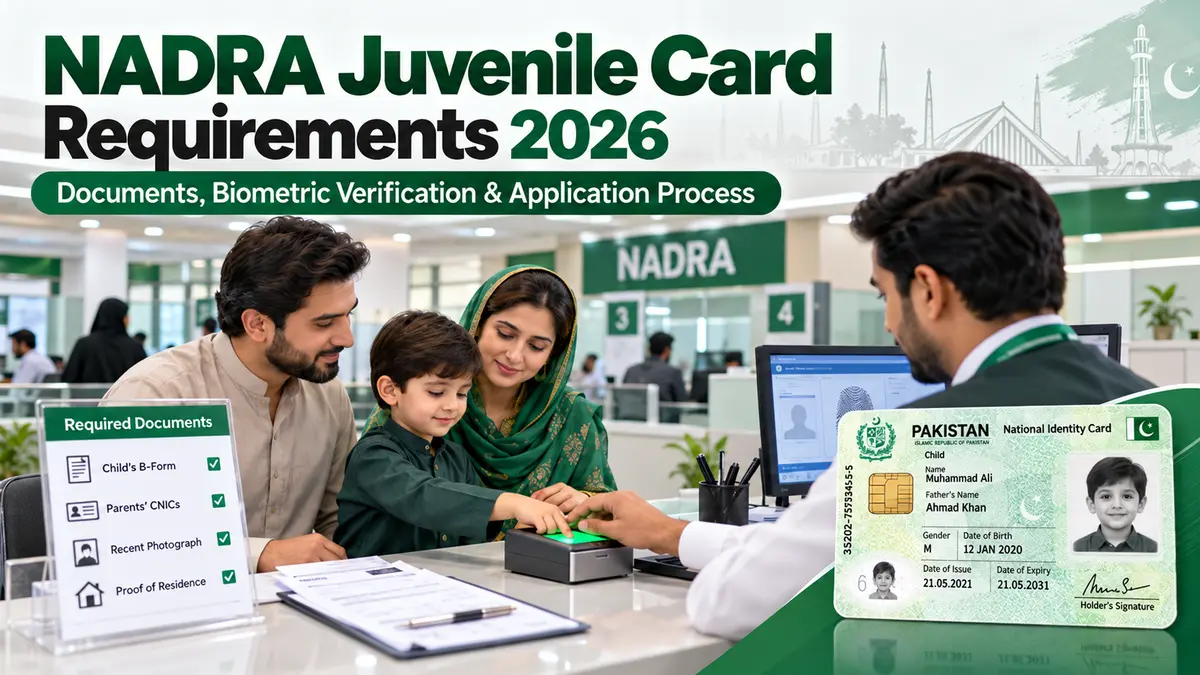
The National Database and Registration Authority (NADRA) has clarified the NADRA Juvenile Card Requirements 2026 for Pakistani parents and legal guardians applying for their children’s identity cards for the first time. The latest instructions, reported on October 16–17, 2026, explain which documents are needed, how biometric verification works, and why the child’s presence is compulsory.
Parents must provide their identity card details along with the child’s B-Form or verified computerized birth registration information. Different supporting documents are required for children born outside Pakistan.
Quick Answer: To apply for a NADRA Juvenile Card in Pakistan, parents need their CNIC number and the child’s B-Form or verified computerized birth certificate with its CRMS number. A parent or legal guardian must complete biometric verification, and the child must be present. Applications can be submitted through a NADRA Registration Centre.

What Is the Latest NADRA Juvenile Card Update for October 2026?
According to the instructions reported on October 16, 2026, NADRA has reminded parents to complete their documentation before applying for a Juvenile Card.
The guidance focuses on first-time applicants and confirms several important requirements:
- The CNIC number of a parent or legal guardian is required.
- The child’s B-Form can be provided if already issued.
- A verified computerized birth certificate with its CRMS number can be used for birth registration information.
- Additional documents apply to children born abroad.
- Biometric verification of a parent or legal guardian is required.
- The child must be physically present during Juvenile Card registration.
These instructions are intended to help families avoid incomplete applications and unnecessary visits to NADRA offices.
Importantly, the latest announcement clarifies application requirements. It should not be confused with a separate announcement introducing new Juvenile Card fees or making the card compulsory for every school admission.
NADRA Juvenile Card Requirements 2026: Complete Documents List
Parents should prepare the necessary records before visiting their nearest NADRA Registration Centre.
| Required document or information | Details |
|---|---|
| Parent or guardian’s CNIC | Identity card number for verification |
| Child’s B-Form (CRC) | Required if already available |
| Computerized birth certificate | Verified birth record with CRMS number when applicable |
| Parent or guardian biometric verification | Required to confirm the family connection |
| Child’s physical presence | Mandatory for Juvenile Card processing |
| Overseas birth documents | Additional evidence for children born outside Pakistan |
NADRA may request supporting documents in cases involving incomplete records, guardianship arrangements, or differences between birth and family registration information.
Is a B-Form Compulsory for a Juvenile Card?
A common question among parents is whether they must obtain a B-Form before applying for a Juvenile Card.
Under the newly reported instructions, parents can provide the child’s B-Form if one has already been issued. Otherwise, verified computerized birth registration information, including the CRMS number, is relevant to the application.
This does not mean that an unregistered child can receive a Juvenile Card without identity checks. NADRA must first establish the child’s identity, birth details, citizenship eligibility, and relationship with the parent or legal guardian.
If the child does not have a B-Form, parents should confirm that the birth registration record is available and correctly entered before visiting NADRA.
What Is a CRMS Number?
CRMS stands for Civil Registration Management System.
The CRMS number is linked to a computerized birth registration record issued through the relevant local government registration authority, such as a Union Council, Municipal Committee, or Cantonment Board.
For example, if a child was born in Lahore and the birth was registered with the relevant Union Council, parents can use the computerized birth record to support the NADRA registration process.
The birth certificate must be verified. A handwritten or unverified document may not meet the applicable requirements.
Also read: How to Apply for CNIC in Pakistan? Step by Step Guide
How to Apply for a NADRA Juvenile Card in Pakistan
Parents can apply through a NADRA Registration Centre. NADRA’s official website also describes an application process through the PakID mobile application, although biometric verification or photographs may still require a physical visit.
Step 1: Check the Child’s Eligibility
A Juvenile Card is issued to Pakistani citizens under 18 years of age.
The card helps establish the child’s registered identity and family relationship in NADRA’s database.
Step 2: Prepare the Required Documents
Before applying, arrange the parent’s or guardian’s identity details, the child’s birth registration information, and any other documents relevant to the case.
Check that the child’s name, date of birth, and parents’ details are consistent across the available records.
Step 3: Visit a NADRA Registration Centre
Take the child to a nearby NADRA Registration Centre with the required documents.
The child’s presence is mandatory for Juvenile Card processing, even if the parent already has the necessary identity information.
Step 4: Complete Registration and Biometric Verification
NADRA staff will process the application and complete the relevant identity verification.
A parent or legal guardian must undergo biometric verification. The child’s photograph and applicable biometric details will also be recorded according to the child’s age.
Step 5: Review the Application Details
Before final submission, check the spelling of names, date of birth, gender, and family information.
Mistakes at this stage can create problems with later identity documents and may require a separate correction request.
Step 6: Pay the Applicable Fee and Track the Application
Complete the required payment based on the available service category.
Keep the application receipt or tracking number to check the application status and collection instructions.
Can Parents Apply for a Juvenile Card Through the PakID App?
Yes. NADRA’s official Juvenile Card service page includes the PakID application as an available application channel.
The general process involves signing in to PakID, selecting New Juvenile Card, entering the required information, uploading documents, and following the verification instructions.
However, applying through the app does not guarantee that the complete procedure can be finished from home. NADRA may require a visit to a Registration Centre for biometric verification and photographs.
Parents can check the official service details at NADRA Juvenile Card Services.
NADRA Juvenile Card Requirements for Children Born Abroad
Pakistani children born outside the country may also qualify for a Juvenile Card, subject to citizenship and identity verification requirements.
For such applications, the recent instructions identify the following possible documents:
- Detailed foreign birth certificate
- S-1 form
- Citizenship certificate
- Naturalization certificate
The applicable document depends on the child’s circumstances and registration history.
For example, parents of a child born in Saudi Arabia, the UAE, or the United Kingdom may need to provide foreign birth registration evidence rather than a Pakistani Union Council birth certificate.
Overseas families should also distinguish between a Juvenile Card and a NICOP. A NICOP may be the relevant identity document for a Pakistani child living abroad, depending on the family’s situation.
Parents should confirm the appropriate document category with NADRA before applying.
NADRA Juvenile Card Age Limits and Biometric Requirements
NADRA applies different biometric and validity rules depending on the child’s age.
| Child’s age | Juvenile Card biometric requirements | Validity milestone |
|---|---|---|
| Below 10 years | Photograph and iris scan | Until age 10 |
| 10 to under 18 years | Photograph, fingerprints and iris scan | Until age 18 |
These age-related rules are stated on NADRA’s official Juvenile Card service page.
A Juvenile Card issued to a younger child therefore should not automatically be assumed to remain valid until the eighteenth birthday.
Parents should check its expiry information and arrange an updated document when required.
Juvenile Card vs B-Form: What Is the Difference?
Both documents are issued by NADRA for Pakistani children under 18, but their format and verification features differ.
| Feature | B-Form (CRC) | Juvenile Card |
|---|---|---|
| Full name | Child Registration Certificate | Juvenile Card |
| Eligible age | Under 18 | Under 18 |
| Document format | Registration certificate | Physical identity card |
| Main purpose | Child registration and identity record | Child identification |
| Photograph and biometrics | Based on age | Based on age |
| Issuing authority | NADRA | NADRA |
The B-Form is commonly used to establish a child’s registered identity for school records and other administrative purposes.
The Juvenile Card provides a card-format identity document with age-appropriate identification features.
Parents should not assume that one document will always replace the other for every service. Schools, passport offices, banks, and other organizations may have their own document requirements.
NADRA Juvenile Card Fee in Pakistan 2026
The Juvenile Card is a paid identity document, and NADRA determines the applicable fee according to its official fee schedule and processing categories.
For an accurate payment amount, applicants should check NADRA’s current fee schedule rather than rely on an older social media post.
The latest October 2026 guidance focuses on documentation and verification. It does not announce a new Juvenile Card fee in the reports reviewed.
Parents can check the current charges and applicable processing timelines through the official NADRA fee structure.
What Happens When a Child Turns 18?
A Juvenile Card is intended for Pakistani citizens below 18 years of age.
Once the child reaches 18, they become eligible to apply for an adult Computerized National Identity Card (CNIC).
A Juvenile Card does not automatically become an adult CNIC. The individual must follow NADRA’s first-time CNIC registration process.
It is useful to ensure that the child’s name, date of birth, and parents’ information are accurate before reaching this stage.
Important Tips to Avoid Juvenile Card Application Delays
Families can reduce the risk of application problems by checking a few details beforehand.
Verify birth registration information. Make sure the computerized birth certificate contains correct details and that its verification status is acceptable.
Check spelling and dates. Differences between a child’s birth certificate, B-Form, and family records may require clarification.
Bring the child. The Juvenile Card application requires the child’s physical presence. Do not assume that a parent can complete the entire process alone.
Plan for biometric verification. If the required parent or guardian is unavailable, contact NADRA to confirm what alternative verification arrangements, if any, apply.
Keep the receipt. Save the tracking details until the application has been processed and the card received.
Families living in areas with limited NADRA office access can also check the availability of NADRA Mobile Registration Van services, which include CRC and Juvenile Card applications.
Frequently Asked Questions (FAQs)
1. What are the new NADRA Juvenile Card requirements in 2026?
Parents need their CNIC details, the child’s B-Form or verified computerized birth registration information, and the necessary biometric verification. The child must also be present during Juvenile Card processing.
2. Can I apply for a Juvenile Card without a B-Form?
The latest instructions allow applicants to provide verified computerized birth registration information where a B-Form has not already been issued. NADRA must still complete the child’s identity and family verification.
3. Is the child’s presence compulsory?
Yes. NADRA explicitly states that children must be present for Juvenile Card applications.
4. Can a legal guardian apply instead of a parent?
Yes, a legal guardian can apply, subject to the required guardianship and identity verification. NADRA may request documents establishing the guardian’s authority.
5. Is a Juvenile Card available for a 5-year-old child?
Yes. A Pakistani child under 18 can be eligible for a Juvenile Card. For children below 10, NADRA requires a photograph and iris scan, according to its official biometric rules.
6. Can a 17-year-old get a Juvenile Card?
Yes. A 17-year-old Pakistani citizen is still below the age limit. However, the card’s validity is linked to the eighteenth birthday, after which an adult CNIC is the appropriate identity document.
7. Can I apply for a Juvenile Card online?
NADRA supports applications through its PakID app. However, some applicants will still need to visit a Registration Centre for biometric or photographic requirements.
8. Is a Juvenile Card the same as a B-Form?
No. Both establish a child’s registered identity, but the Juvenile Card is issued in card format, while the B-Form is a Child Registration Certificate.
9. What if the child’s birth certificate has incorrect information?
Parents should have the incorrect birth registration details addressed by the relevant issuing authority or follow NADRA’s correction requirements before proceeding. Inconsistent records may delay the application.
10. Where can I confirm official NADRA Juvenile Card requirements?
Applicants can visit the official website, www.nadra.gov.pk, use the PakID app, or contact a NADRA Registration Centre.
Conclusion
The NADRA Juvenile Card Requirements 2026 update provides important guidance for Pakistani parents applying for their children’s identity cards for the first time.
The main requirements are straightforward: prepare the parent’s or legal guardian’s CNIC details, provide the child’s B-Form or verified birth registration information, complete biometric verification, and ensure the child is present during registration.
Families with children born abroad should also arrange the relevant foreign birth or citizenship documents.
By checking these requirements in advance, parents can avoid common documentation problems and make the application process easier. For the latest charges, processing times, and special-case requirements, we recommend consulting NADRA’s official website before submitting an application.
Is this conversation helpful so far?
Also read: How to Apply for B-Form (Child Registration Certificate)?