
Solar Panels Required For a 1 Ton AC in Pakistan: Full Guide
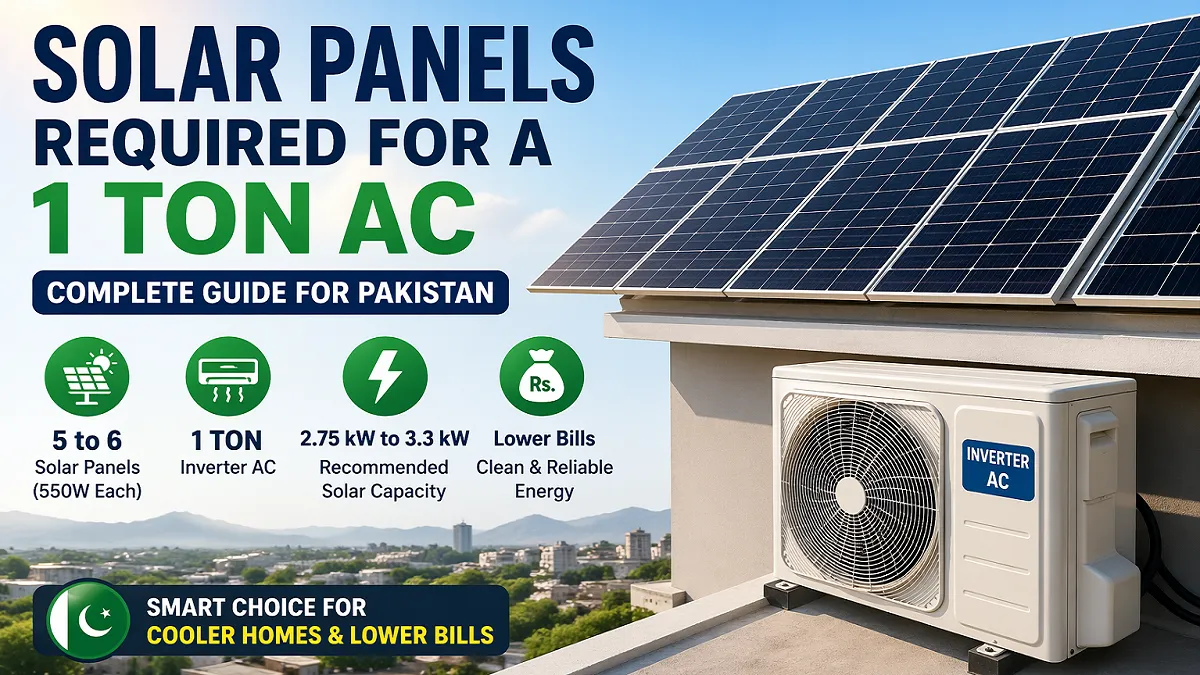
As electricity prices stay high and summer heat remains intense, many households in Pakistan are exploring solar as a practical way to run air conditioning at a lower monthly cost. When people ask about solar panels required for a 1 ton AC, they usually want one exact number, but the real answer depends on power consumption, panel size, sunlight, inverter losses, and whether the system will run only the AC or other appliances too. Pakistan has strong solar potential overall, which is one reason rooftop solar adoption has accelerated sharply in recent years.
If you are planning a solar setup for your air conditioner, understanding the AC’s power need, the output of modern solar panels, and basic system sizing will help you avoid an undersized system. In simple terms, most homes will need a practical solar system of around 2.5 kW to 3.5 kW for a 1 ton inverter AC, which often translates to about 5 to 6 panels of 550W each, depending on conditions. That is a more realistic approach than relying on a bare minimum figure.
Power Needs of a 1 Ton Inverter AC
Before calculating the solar panels required for a 1 ton AC, the first step is to understand how much electricity the AC actually uses.
A 1 ton air conditioner is generally a 12,000 BTU/h unit, and product specifications for 1 ton inverter split AC models from Dawlance show cooling capacity at that level, with some 1 ton models listing maximum cooling power input around 1.35 kW. In practice, inverter ACs do not draw the same power continuously because they adjust compressor speed according to the room’s cooling demand.

That means a 1 ton inverter AC may:
- draw higher power when starting cooling in a very hot room
- consume less after the target temperature is reached
- use more electricity in poor insulation or extreme summer heat
For planning purposes, many homeowners treat a 1 ton inverter AC as a load that may commonly operate in roughly the 0.9 kW to 1.35 kW range depending on conditions, with daily energy use based on how many hours it runs. A simple example looks like this:
- If the AC averages 1.0 kW for 8 hours, daily use is about 8 kWh
- If it averages 1.2 kW for 8 hours, daily use is about 9.6 kWh
That daily energy need is what the solar system must cover if your goal is to run the AC mainly from solar during the day.
Calculating How Many Solar Panels Are Needed
To estimate the solar panels required for a 1 ton AC, you need to look at three main things:
- AC power consumption in watts or kilowatts
- solar panel wattage
- effective solar production hours
Pakistan has favorable solar conditions, and datasets and mapping resources from World Bank-supported solar platforms show strong solar resource potential across the country.
Here is the practical way to think about the calculation:
Example 1: Using 550W panels
Suppose your 1 ton inverter AC needs about 8 to 9 kWh per day.
A 550W panel does not produce its full rating all day, but over a good sunny day it can contribute meaningful daily generation. When real-world losses are considered, a system of around 2.75 kW to 3.3 kW is often a safer planning point for daytime AC operation.
That means:
- 5 panels × 550W = 2.75 kW
- 6 panels × 550W = 3.3 kW
For many households, 5 to 6 panels of 550W is the most practical answer.
Example 2: Using 400W panels
If you use lower-wattage panels:
- 6 panels × 400W = 2.4 kW
- 7 panels × 400W = 2.8 kW
- 8 panels × 400W = 3.2 kW
So a setup based on 400W panels usually needs more panels than a setup using newer 550W or 580W panels.
Quick rule of thumb
For a 1 ton inverter AC in Pakistan:
| Panel Size | Approximate Panels Needed |
|---|---|
| 400W | 6 to 8 panels |
| 450W | 6 to 7 panels |
| 550W | 5 to 6 panels |
| 580W | 5 to 6 panels |
| 700W | 4 to 5 panels |
This is a practical range, not a fixed rule. The final number depends on how hard the AC has to work and how much safety margin you want.
Factors That Affect the Number of Solar Panels
The number of solar panels required for a 1 ton AC can change because of several real-world factors.
Sunlight Availability
Roof direction, shading, dust, weather, and city conditions all affect output. Pakistan overall has strong solar potential, but one rooftop may still perform much better than another because of shade, tilt, or dirt buildup.
Inverter Efficiency
The solar inverter affects how much usable power reaches the AC. Lower-quality inverters usually waste more energy, while better inverters give more stable performance under changing loads.
Energy Usage Patterns
If you run the AC for longer hours, especially in May, June, and July, you may need more solar capacity. The same is true if fans, lights, refrigerators, or other appliances operate alongside the AC.
Room Conditions
A top-floor room, poor insulation, direct afternoon sun, and frequent door opening can all increase the AC’s electricity consumption.
Battery Backup
If you want backup for load shedding or night use, you usually need more solar capacity and a properly sized battery bank. A battery-based setup is very different from a daytime-only solar arrangement.
Example Solar Setup for 1 Ton Inverter AC
Let us take a practical example for a Pakistani home using a 1 ton inverter AC mainly during daytime.
| Component | Specification | Quantity |
|---|---|---|
| AC Load | 1 ton inverter AC | 1 unit |
| Solar Panels | 550W panels | 5 to 6 panels |
| Solar Capacity | 2.75 kW to 3.3 kW | 1 setup |
| Inverter | Around 3 kW class, depending on total load | 1 unit |
| Battery | Optional in hybrid system | As needed |
This type of setup can be suitable for:
- running one 1 ton inverter AC in daytime
- handling normal summer use more comfortably
- allowing some margin for losses and changing weather
If you also want to run small loads like fans, lights, or a refrigerator at the same time, moving toward a 3.5 kW to 4 kW system is often more comfortable.
Common Mistakes to Avoid When Setting Up Solar Panels for ACs
Choosing Low-Efficiency Panels
Cheaper panels may reduce overall value if their real-world performance is weak. Always look at panel wattage, warranty, brand credibility, and expected output.
Ignoring Installation Angle and Shade
Even a good solar system can underperform if panels are shaded by water tanks, nearby walls, or trees. Roof layout matters.
Underestimating Power Usage
Many people size the system only for the AC and forget that other devices may be running at the same time. That often leads to disappointment.
Treating Tonnage as the Only Metric
A 1 ton label does not tell the whole story. Actual energy use depends on the specific model, room conditions, and temperature setting.
Forgetting Dust and Heat Losses
In Pakistan, dust and high summer temperatures can reduce practical solar output. Systems should be sized with some margin instead of using ideal lab assumptions.
Reliable Places to Buy Solar Equipment in Pakistan
When buying solar equipment in Pakistan, focus on these factors instead of choosing only by price:
- genuine panel and inverter brands
- proper warranty coverage
- installer experience
- after-sales service
- correct load assessment
- safe wiring and protection equipment
The better approach is to compare multiple reputable solar installers or dealers and ask for a written load calculation. That helps you judge whether the proposed number of panels is realistic for your AC and your other household usage.
Also read: Solar Inverter Price in Pakistan 2026: The Ultimate Guide
Tips to Make the Most of Your Solar-Powered AC
Keep the Panels Clean
Dust reduces output. Regular cleaning can noticeably improve production, especially in dry and dusty months.
Reduce Heat Gain Inside the Room
Curtains, insulation, sealed windows, and reduced direct sunlight help the AC work less.
Use Sensible Temperature Settings
Moderate settings usually improve efficiency and reduce compressor strain.
Monitor Your Solar Output
A good inverter app or monitoring screen helps you understand how much energy your system is actually producing.
Leave Some Margin in the Design
A slightly larger solar system often performs much better than a strict minimum design.
Also read: Solar Panel Price in Pakistan 2025: The Ultimate Guide
Frequently Asked Questions
How many Solar Panels Required for a 1 Ton AC in Pakistan?
In most Pakistani homes, the Solar Panels Required for a 1 Ton AC usually come to 5 to 6 panels of 550W each for practical daytime use. If you are using lower-wattage panels such as 400W, the required number may increase to around 6 to 8 panels.
What affects the Solar Panels Required for a 1 Ton AC?
The Solar Panels Required for a 1 Ton AC depend on several factors, including the AC’s actual power consumption, the number of hours you use it daily, the wattage of the solar panels, inverter efficiency, sunlight availability, roof conditions, and whether you want to run other appliances on the same system.
Can a 3 kW system meet the Solar Panels Required for a 1 Ton AC?
Yes, in many cases, a 3 kW solar system can meet the Solar Panels Required for a 1 Ton AC, especially if the AC is energy-efficient and mainly used during sunny daytime hours. However, if the room is very hot, poorly insulated, or other appliances are also running, a slightly larger system may perform better.
Do I need batteries for a solar AC setup?
Not always. If your main goal is to reduce daytime electricity bills, batteries may not be necessary. However, if you want to run the AC during load shedding or at night, then a hybrid system with battery backup may be a better option.
Can I run other appliances along with a 1 ton AC on solar?
Yes, but the system size should be increased accordingly. If fans, lights, a refrigerator, or other household devices will run alongside the AC, you may need more solar capacity than a setup designed for the AC alone.
Is it possible to run a 1 ton AC completely off-grid?
Yes, it is possible, but it requires a properly designed off-grid system with sufficient solar panels, a strong inverter, and enough battery storage. This type of setup is usually more expensive than a standard on-grid or daytime-use solar system.
Also read: Types of New Solar Systems – Which One is Best?
Conclusion (Solar Panels Required for a 1 Ton AC)
If you are trying to estimate the solar panels required for a 1 ton AC, the practical answer for most homes in Pakistan is usually around 5 to 6 panels of 550W each, or a total system size near 2.75 kW to 3.3 kW for daytime use. If you use lower-wattage panels, the number of panels goes up. Moreover, If you want to run other appliances or add backup, the system size should increase further.
The smartest way to plan the setup is not to chase the smallest possible number of panels. Instead, size the system according to real AC consumption, local roof conditions, inverter quality, and the rest of your household load. That produces better comfort, better savings, and fewer surprises in peak summer.