
Australia Skilled Worker Visa New Salary Rules Updated 2026
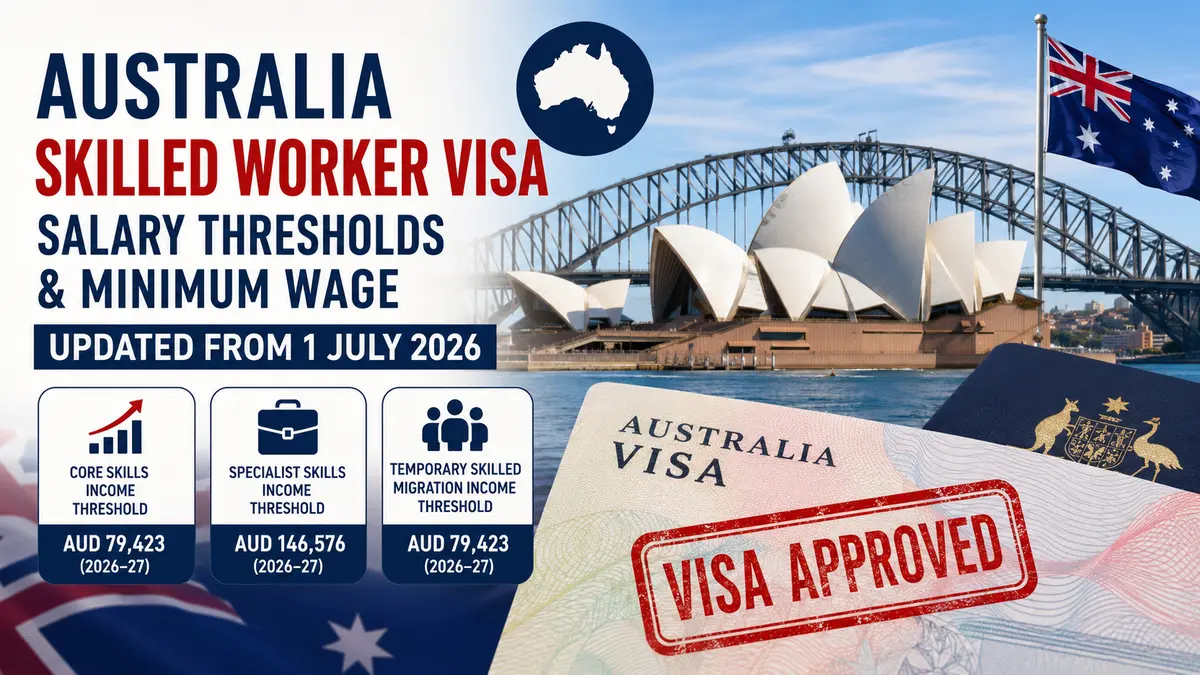
Australia Skilled Worker Visa Rules: Australia has raised the minimum salary requirements for several employer-sponsored skilled visas from 1 July 2026, making it more expensive for employers to sponsor overseas professionals. The updated income thresholds are designed to keep migrant wages aligned with Australian earnings while protecting local workers from wage undercutting. Existing visa holders are generally unaffected, but new applicants must meet the higher salary requirements.
Australia continues to rely on skilled migration to address workforce shortages across healthcare, engineering, technology, construction, education, and regional industries. However, the government regularly adjusts visa settings to ensure the migration system supports economic growth while maintaining fair wages for Australian workers.
The latest increase in salary thresholds is one of the most significant immigration updates introduced this year and directly affects employers planning to hire overseas talent.
Australia Raises Skilled Worker Visa Salary Thresholds
The Australian Government has increased the salary thresholds for employer-sponsored skilled visas by approximately 3.8%, reflecting annual wage growth measured through Average Weekly Ordinary Time Earnings (AWOTE). This adjustment is part of Australia’s annual indexation process rather than a one-time immigration reform.

The revised salary requirements apply to new employer nomination applications lodged on or after 1 July 2026.
Applicants whose nominations were submitted before the implementation date continue to be assessed under the previous thresholds, while current visa holders are not required to meet the updated salary figures solely because of this change.
New Australia Skilled Worker Visa Salary Thresholds
The government has introduced higher minimum salaries across the major employer-sponsored skilled migration streams.
| Income Threshold | Previous | New (From 1 July 2026) |
|---|---|---|
| Core Skills Income Threshold (CSIT) | AUD 76,515 | AUD 79,499 |
| Temporary Skilled Migration Income Threshold (TSMIT)* | AUD 76,515 | AUD 79,499 |
| Specialist Skills Income Threshold (SSIT) | AUD 141,210 | AUD 146,717 |
*The Temporary Skilled Migration Income Threshold aligns with the Core Skills threshold under the current framework.
Although the increases appear modest, they may affect thousands of future sponsorship applications because employers must satisfy both the applicable income threshold and the market salary rate.
Why Australia Increased the Salary Requirements?
The Australian Government reviews skilled migration salary thresholds every year to ensure overseas workers receive wages comparable to Australian employees performing similar work.
The policy has several objectives:
- Prevent employers from using overseas recruitment to reduce wage costs.
- Ensure skilled migration addresses genuine labour shortages.
- Keep sponsored workers’ salaries aligned with national wage growth.
- Maintain public confidence in Australia’s skilled migration system.
- Encourage employers to recruit highly qualified professionals when overseas sponsorship is necessary.
Rather than restricting skilled migration, the government says the updated thresholds help preserve the integrity of employer-sponsored visa programs.
Which Australia Skilled Worker Visas Are Affected?
The higher salary thresholds primarily apply to employer-sponsored migration pathways.
Skills in Demand Visa (Subclass 482)
Australia’s Skills in Demand Visa remains one of the country’s most popular temporary employer-sponsored visas.
The new salary thresholds apply to:
- Core Skills Stream
- Specialist Skills Stream
Employers nominating overseas workers under these streams must ensure the offered salary meets the updated minimum threshold or the Annual Market Salary Rate (AMSR), whichever is higher.
Employer Nomination Scheme (Subclass 186)
Many permanent residency applicants use the Employer Nomination Scheme.
Since its salary requirement aligns with the Core Skills threshold, nominations lodged after 1 July 2026 generally need to satisfy the higher income requirement.
Skilled Employer Sponsored Regional Visa (Subclass 494)
Regional employers recruiting overseas professionals are also affected by the revised salary settings.
Applicants pursuing regional employment opportunities must ensure their nominated salary complies with the updated requirements.
Who Will Be Affected Most?
The revised salary thresholds will have different effects depending on whether someone is an employer, a new applicant, or an existing visa holder.
New Skilled Worker Applicants
People planning to apply after 1 July 2026 may need:
- Higher salary offers
- Employers willing to increase remuneration
- Better negotiation before accepting sponsorship
Applicants whose offered salaries fall below the required threshold may no longer qualify for sponsorship under the affected visa streams.
Australian Employers
Businesses that rely on overseas recruitment may experience:
- Higher labour costs
- Revised recruitment budgets
- Additional salary planning before lodging nominations
- Greater emphasis on attracting experienced professionals
Large employers may adapt more easily, while smaller businesses could face additional financial pressure.
Existing Visa Holders
Current sponsored workers generally do not need to meet the revised thresholds simply because the rules changed. The new salary levels primarily apply to new nomination applications lodged from the implementation date onward.
Does This Mean Australia Is Reducing Skilled Migration?
Not necessarily.
Australia continues to face labour shortages across multiple industries, particularly in sectors requiring specialized expertise.
Instead of reducing migration numbers outright, the government is attempting to ensure that employer-sponsored migration attracts genuinely skilled professionals while maintaining wage standards for Australian workers.
This approach reflects Australia’s broader migration strategy of balancing economic needs with workforce protections.
Why the Changes Matter for International Professionals?
For many skilled workers, Australia remains one of the world’s most attractive destinations because of:
- Strong labour protections
- Competitive salaries
- Clear permanent residency pathways
- High quality of life
- Demand for experienced professionals
The updated salary thresholds do not eliminate these opportunities. Instead, they raise the financial benchmark that employers must meet before sponsoring overseas talent.
For highly qualified professionals in sectors experiencing persistent shortages, these changes are unlikely to reduce demand significantly. In some cases, they may even result in higher starting salaries because employers must meet stricter minimum income requirements.
Which Occupations Could Feel the Biggest Impact?
Although the revised salary thresholds apply across employer-sponsored skilled visa programs, their practical impact will vary by occupation and industry.
Professionals already earning well above the minimum thresholds are unlikely to experience major changes. However, occupations where salaries typically sit close to the minimum income requirement may become more difficult to sponsor unless employers increase pay.
Healthcare
Australia continues to experience shortages in several healthcare professions, including:
- Registered nurses
- Aged care professionals
- Medical laboratory scientists
- Physiotherapists
- Medical specialists
Most experienced healthcare professionals already earn salaries above the updated thresholds, meaning sponsorship opportunities are expected to remain strong.
Information Technology
Technology remains one of Australia’s highest-demand sectors. Occupations such as:
- Software engineers
- Cybersecurity specialists
- Cloud architects
- Data scientists
- AI and machine learning engineers
- DevOps engineers
generally command salaries that exceed the revised minimums, making them less affected by the changes.
Engineering
Engineering continues to be a priority occupation area, particularly for:
- Civil engineers
- Mechanical engineers
- Mining engineers
- Electrical engineers
- Structural engineers
- Environmental engineers
Many employers in infrastructure and mining already offer competitive salaries, reducing the impact of the higher thresholds.
Construction
Australia’s ongoing housing and infrastructure projects continue to create demand for skilled workers, including:
- Quantity surveyors
- Construction managers
- Project engineers
- Site supervisors
- Building inspectors
Some entry-level sponsored positions may require salary adjustments to remain eligible.
Education
Qualified teachers remain in demand across Australia, particularly in:
- Secondary education
- Mathematics
- Science
- Special education
- Early childhood education
Government workforce planning suggests continued recruitment of overseas educators in shortage areas.
What Employers Need to Know About Australia Skilled Worker Visa Salary?
Australian employers planning to sponsor overseas workers should carefully review their recruitment strategies before submitting new nominations.
Review Salary Packages
Employers should ensure the proposed annual salary:
- Meets the applicable income threshold.
- Meets or exceeds the Annual Market Salary Rate.
- Is comparable to Australian employees performing similar work.
Meeting only one of these requirements is not sufficient.
Update Employment Contracts
Businesses may need to revise:
- Employment agreements
- Offer letters
- Payroll budgets
- Internal salary bands
before lodging employer nomination applications.
Budget for Higher Recruitment Costs
Although the increase represents only a few thousand Australian dollars annually, organizations sponsoring multiple overseas workers could see a noticeable rise in labor costs.
What Skilled Workers Should Do Before Applying For Australia Skilled Worker Visa
If you plan to apply for an Australia Skilled Worker Visa, preparation is more important than ever.
Confirm Your Salary Offer
Before accepting sponsorship, ensure the offered salary satisfies:
- The relevant income threshold.
- The market salary rate.
- Any industry award or enterprise agreement requirements.
Do not assume that receiving a job offer automatically guarantees visa eligibility.
Check Your Occupation
Verify that your occupation remains eligible under the relevant employer-sponsored visa pathway.
Occupation lists and eligibility requirements may change independently of salary threshold updates.
Improve Your Competitiveness
Applicants with stronger qualifications generally receive better salary offers.
Consider strengthening your profile through:
- Additional certifications
- Australian-recognized qualifications
- Higher English language scores
- Relevant work experience
- Professional licensing where required
How Australia Compares With Other Popular Skilled Migration Destinations?
Australia is not the only country adjusting immigration policies to reflect changing labor markets and wage growth.
| Country | Recent Trend |
|---|---|
| Australia | Higher salary thresholds for employer-sponsored visas |
| United Kingdom | Increased salary thresholds for Skilled Worker Visas and tighter immigration rules |
| Canada | Continued focus on targeted skilled immigration with occupation-specific pathways |
| New Zealand | Periodic wage threshold adjustments for accredited employer visas |
| Germany | Expanding opportunities for qualified professionals while modernizing immigration rules |
Many developed economies are shifting toward attracting highly skilled professionals while ensuring migrant workers receive competitive wages.
Australia’s latest changes align with this broader international trend.
Common Misconceptions About the New Australia Skilled Worker Visa Salary Rules
“Existing Visa Holders Must Receive an Immediate Pay Raise”
Not necessarily.
The updated thresholds primarily apply to new employer nomination applications lodged after the implementation date. Existing sponsored workers are generally not required to have their salaries automatically increased solely because the thresholds changed.
“Australia Is Closing Its Doors to Skilled Migrants”
This is incorrect.
Australia continues to welcome skilled migrants to address labor shortages. The government is simply raising the minimum salary standards for employer-sponsored recruitment.
“Every Occupation Needs a Salary Above the Threshold”
Not exactly.
Employers must generally pay whichever is higher:
- the applicable visa income threshold, or
- the Annual Market Salary Rate for that occupation.
This means many professionals will already be earning well above the minimum threshold.
What Could Happen Next?
Australia reviews skilled migration policies regularly.
Future changes may include:
- Additional annual salary indexation.
- Updates to occupation lists.
- New regional migration incentives.
- Adjustments to permanent residency pathways.
- Reforms responding to labor market shortages.
Both employers and skilled workers should monitor announcements from the Department of Home Affairs before submitting applications.
Expert Tips for Australia Skilled Worker Visa Applicants
To improve your chances of success:
- Begin your job search early.
- Target occupations experiencing genuine skill shortages.
- Research average salaries in your profession.
- Negotiate salary packages before accepting sponsorship.
- Ensure your qualifications are recognized in Australia.
- Prepare all documentation before receiving a nomination.
- Follow official immigration updates rather than relying solely on social media or unofficial sources.
A well-prepared application is more likely to proceed smoothly and avoid delays caused by salary or eligibility issues.
What This Means for the Future of Australia’s Skilled Migration Program?
The latest salary threshold increases reinforce Australia’s commitment to attracting qualified professionals while protecting local wage standards.
Although the higher minimum salaries may increase recruitment costs for employers, they also help ensure that overseas workers receive fair compensation comparable to Australian employees.
For skilled professionals with experience in high-demand industries such as healthcare, engineering, information technology, education, and construction, Australia remains one of the world’s most attractive destinations for career growth and long-term migration.
Applicants should focus on securing competitive job offers, understanding the latest visa requirements, and staying informed about future immigration updates to maximize their chances of success.
Frequently Asked Questions
1. What is the new Australia Skilled Worker Visa salary threshold?
From 1 July 2026, the Core Skills Income Threshold increased to AUD 79,499, while the Specialist Skills Income Threshold increased to AUD 146,717 for eligible employer-sponsored visa applications.
2. Do existing visa holders need to meet the new salary requirements?
Generally, no. The revised thresholds primarily apply to new employer nomination applications lodged after the implementation date.
3. Which visas are affected by the salary increase?
The updated thresholds affect several employer-sponsored pathways, including the Skills in Demand (Subclass 482), Employer Nomination Scheme (Subclass 186), and Skilled Employer Sponsored Regional (Subclass 494) visas.
4. Why did Australia increase the salary thresholds?
The government adjusts salary thresholds annually to reflect wage growth, protect Australian workers from wage undercutting, and ensure overseas professionals receive fair market-based salaries.
5. Will it now be harder to get an Australia Skilled Worker Visa?
For applicants whose job offers are close to the minimum salary requirement, obtaining sponsorship may become more challenging unless employers increase salaries. Highly skilled professionals earning competitive wages are less likely to be affected.
6. Does the new threshold guarantee visa approval?
No. Meeting the salary requirement is only one part of the eligibility criteria. Applicants must also satisfy occupation, skills assessment (where applicable), English language, health, character, and visa-specific requirements.
7. Can employers offer more than the minimum salary threshold?
Yes. Many employers already pay well above the minimum threshold to attract experienced professionals, particularly in industries facing severe skill shortages.
8. Should applicants wait for future immigration changes before applying?
Unless additional reforms directly affect your eligibility, delaying an application solely in anticipation of future changes may not be beneficial. If you meet the current requirements and have an eligible job offer, applying under the existing rules is generally the most practical approach.
Conclusion (Australia Skilled Worker Visa Rules)
Australia’s decision to increase the Australia Skilled Worker Visa salary thresholds reflects its ongoing effort to balance skilled migration with fair wage standards for local workers. While the higher income requirements may increase recruitment costs for employers and raise the entry bar for some applicants, they do not signal a reduction in opportunities for qualified overseas professionals. Instead, the changes aim to ensure that employer-sponsored migrants receive salaries that align with Australia’s growing labor market and economic conditions.
For prospective applicants, the key to a successful Australia Skilled Worker Visa application is staying informed about the latest immigration rules, securing a competitive job offer, and ensuring all eligibility requirements are met before applying. Skilled professionals in high-demand sectors such as healthcare, engineering, information technology, construction, and education are expected to remain well-positioned despite the updated salary thresholds. By understanding the new requirements and preparing accordingly, both employers and skilled workers can continue to benefit from Australia’s employer-sponsored migration pathways.
Also read: UK Skilled Worker Visa: Eligible Jobs to Be Reduced