
NADRA Launches Free Iris Scan Service Across Pakistan Now!
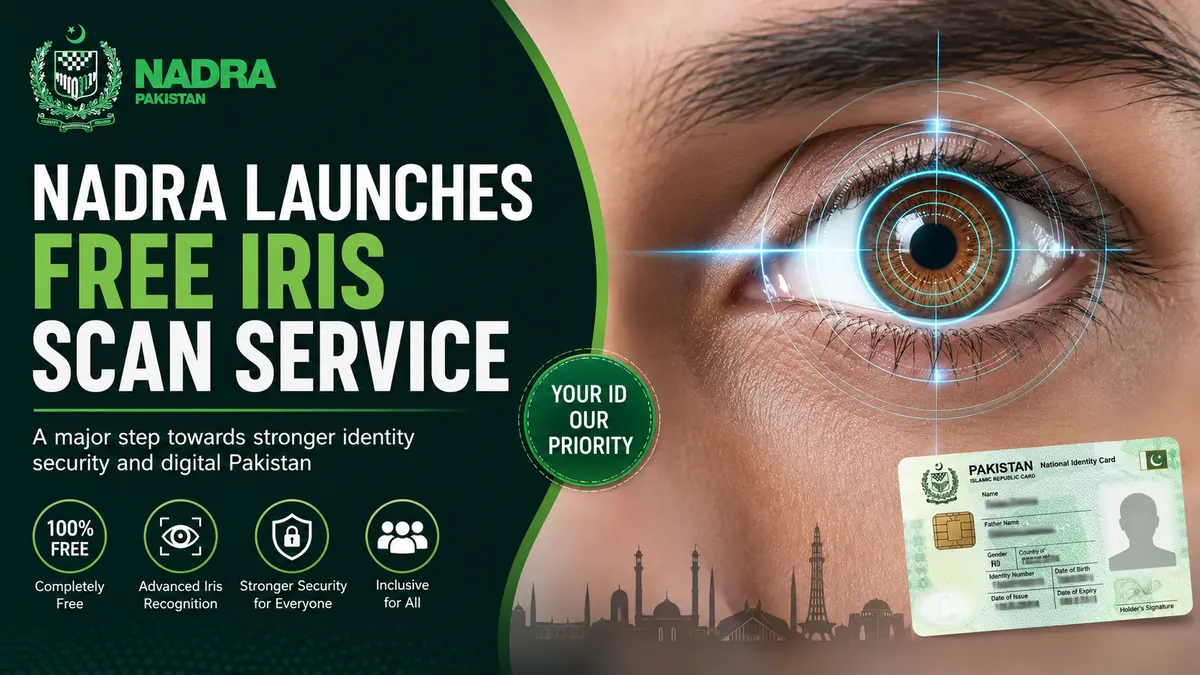
Pakistan’s National Database and Registration Authority (NADRA) has launched a free iris scan service across the country to enhance biometric identity verification and make public services more accessible. The new initiative allows citizens to verify their identity through iris recognition at no additional cost, particularly benefiting people whose fingerprints cannot be authenticated due to age, physical labor, or medical conditions.
The nationwide rollout represents another major step in Pakistan’s digital identity system. By introducing iris-based biometric verification alongside fingerprint authentication, NADRA aims to reduce identity fraud, improve access to government services, and ensure that every eligible citizen can verify their identity accurately.
NADRA Launches Free Iris Scan Service: What Has Changed?
NADRA has officially introduced a free iris scan service at selected registration centers and verification facilities across Pakistan. The initiative provides citizens with an alternative biometric verification method when fingerprint authentication fails or becomes unreliable.

The announcement follows growing concerns over fingerprint verification challenges faced by thousands of Pakistanis every year. Elderly citizens, laborers, farmers, factory workers, and people with damaged fingerprints often encounter difficulties when verifying their identity for various government and financial services.
With the new service, trained operators capture high-resolution images of an individual’s iris using specialized biometric cameras. Since the iris contains unique patterns that remain largely unchanged throughout a person’s lifetime, it provides one of the most accurate forms of biometric identification available today.
Unlike fingerprints, which may become worn over time, iris recognition offers a reliable backup verification method that significantly improves the overall effectiveness of Pakistan’s national identity system.
Why NADRA Introduced the Free Iris Scan Service
NADRA launched the free iris scan service to modernize Pakistan’s digital identity infrastructure and ensure that biometric limitations do not prevent any citizen from accessing identity verification services.
Several factors contributed to the introduction of the new system.
Increasing Cases of Fingerprint Verification Failure
Many Pakistanis experience fingerprint verification problems due to:
- Advanced age
- Continuous manual labor
- Burns or hand injuries
- Certain medical conditions
- Naturally faint fingerprints
When the system cannot match a citizen’s fingerprints successfully, the citizen may experience delays in accessing government services or completing important transactions.
The iris scan provides a dependable alternative that reduces these verification failures.
Stronger Protection Against Identity Fraud
Identity theft and impersonation remain concerns for governments worldwide. By adding another highly secure biometric identifier, NADRA can further strengthen the integrity of Pakistan’s national database.
Since every person’s iris pattern is unique—even among identical twins—it is extremely difficult to duplicate or forge.
Better Access to Public Services
Many essential services depend on biometric verification. The free iris scan service helps ensure that citizens who struggle with fingerprint authentication can continue accessing:
- Government welfare programs
- Pension payments
- Banking services
- SIM registration
- Identity verification processes
- Other public sector services requiring biometric confirmation
What Is Iris Recognition Technology?
Iris recognition is an advanced biometric technology that identifies individuals by analyzing the unique patterns found in the colored portion of the human eye surrounding the pupil.
Unlike facial recognition, which aging, lighting conditions, or facial expressions can affect, iris recognition analyzes highly detailed natural patterns in the iris that remain remarkably stable throughout a person’s life.
During the verification process, a specialized infrared camera captures an image of the eye without making physical contact.
The software then converts the iris pattern into a secure digital biometric template. During future verification attempts, the system compares the newly captured iris pattern with the encrypted record stored in NADRA’s database.
If both records match, the person’s identity is successfully verified.
The process typically takes only a few seconds and does not involve any physical contact with the scanning device.
Is the NADRA Iris Scan Service Really Free?
Yes.
According to NADRA’s announcement, the authority is offering the iris scan service completely free of charge. Eligible citizens do not have to pay any additional fee for iris enrollment or verification.
This decision reflects NADRA’s objective of improving accessibility rather than creating another paid verification process.
By eliminating additional charges, the authority hopes more citizens will benefit from stronger and more reliable biometric authentication without facing financial barriers.
Who Can Benefit Most from the Free Iris Scan Service?
Although the service is available to improve identity verification generally, several groups are expected to benefit the most.
Elderly Citizens
As people age, fingerprint ridges naturally become less distinct. Many senior citizens experience repeated biometric verification failures.
Iris recognition offers them a more dependable authentication method.
Daily Wage Workers and Laborers
Construction workers, farmers, mechanics, factory employees, and other manual laborers frequently develop worn fingerprints after years of physical work.
For many of these individuals, fingerprint verification has become increasingly difficult.
The new iris scan service provides a practical alternative.
People with Medical Conditions
Certain medical conditions or injuries may permanently affect fingerprint quality.
The iris remains largely unchanged throughout life, making it a suitable biometric identifier even when fingerprints cannot be captured successfully.
Citizens Facing Repeated Verification Problems
Anyone who repeatedly encounters fingerprint authentication failures during identity verification may benefit from iris-based authentication where available.
How Does the NADRA Iris Scan Process Work?
The verification process has been designed to be quick, secure, and user-friendly.
Step 1: Visit a Participating NADRA Registration Center
Citizens requiring iris verification can visit designated NADRA Registration Centers where iris scanning equipment has been installed.
Step 2: Identity Verification
NADRA staff first verify the applicant’s identity using existing records before initiating the biometric enrollment or verification process.
Step 3: Iris Image Capture
A specialized biometric camera captures detailed images of both eyes.
The process is completely contactless and generally takes only a few seconds.
Step 4: Digital Matching
The captured iris pattern is securely compared with NADRA’s biometric database to confirm the individual’s identity.
Step 5: Successful Authentication
Once verified, the citizen can proceed with the relevant service or transaction requiring biometric confirmation.
Where Is the Free Iris Scan Service Available?
NADRA has announced the service as a nationwide initiative, with deployment beginning through its registration network across Pakistan.
The authority is expected to expand the availability of iris scanning equipment progressively across more NADRA Registration Centers and facilities to ensure broader public access.
Citizens visiting a registration center may be offered iris verification when fingerprint authentication fails or when staff determine that iris recognition is the more appropriate verification method.
As implementation continues, more centers across urban and rural areas are expected to receive the necessary biometric equipment, making the service increasingly accessible throughout the country.
How This Initiative Supports Pakistan’s Digital Identity System
The introduction of iris recognition is more than just a technological upgrade—it strengthens Pakistan’s overall digital identity ecosystem.
Rather than relying solely on fingerprints, NADRA now has an additional highly accurate biometric identifier that improves verification reliability while reducing authentication failures.
This multi-layered biometric approach helps improve the efficiency of identity verification across numerous sectors, including public services, financial institutions, telecommunications, and government benefit programs.
By expanding its biometric capabilities, NADRA continues to modernize Pakistan’s identity management infrastructure while ensuring greater inclusion for citizens who previously faced challenges during fingerprint-based verification.
Iris Scan vs Fingerprint Verification: What’s the Difference?
Both fingerprint and iris recognition are trusted biometric technologies, but each has its own strengths. NADRA’s decision to offer both methods gives citizens a more reliable and flexible identity verification system.
| Feature | Fingerprint Verification | Iris Recognition |
|---|---|---|
| Biometric Used | Fingerprint ridges | Unique iris patterns |
| Contact Required | Usually yes | No (contactless) |
| Accuracy | Very high | Extremely high |
| Affected by Age or Manual Labor | Yes | Rarely |
| Best For | Everyday biometric verification | Backup and advanced identity verification |
| Risk of Authentication Failure | Higher for worn fingerprints | Significantly lower |
Rather than replacing fingerprint verification, the free iris scan service complements it. If fingerprint authentication is unsuccessful, iris recognition can serve as a dependable alternative, ensuring citizens are not denied access to services simply because their fingerprints cannot be verified.
How the Free Iris Scan Service Will Improve Public Services?
NADRA’s latest initiative is expected to improve identity verification across a wide range of public and private services that rely on biometric authentication.
Faster Government Services
Many government departments require biometric verification before processing applications or releasing benefits. When fingerprint verification fails, citizens often have to make multiple visits or undergo additional verification procedures.
The availability of iris recognition can reduce these delays and make service delivery more efficient.
Improved Access to Financial Services
Banks and financial institutions increasingly use biometric verification for customer identification. Individuals who previously experienced fingerprint authentication issues may now have a more reliable method of confirming their identity.
This could help streamline account verification, customer authentication, and other banking processes that depend on biometric checks.
Better Support for Social Welfare Programs
Several government assistance programs rely on biometric verification to ensure that benefits reach the correct recipients.
Introducing iris recognition provides an additional layer of authentication while helping genuine beneficiaries who cannot verify their fingerprints successfully.
Enhanced Digital Identity Infrastructure
Pakistan has continued investing in digital governance and secure identity management. Adding iris recognition strengthens the country’s biometric ecosystem and supports future digital services that require highly accurate identity verification.
Security Benefits of Iris Recognition
One of the biggest advantages of iris recognition is its exceptional level of security.
Every person’s iris contains highly detailed patterns that develop naturally before birth and remain remarkably stable throughout life. Even identical twins have completely different iris patterns.
This provides several important security benefits.
Greater Protection Against Identity Fraud
Because iris patterns are extraordinarily difficult to duplicate, the technology makes impersonation significantly more challenging.
This strengthens the integrity of Pakistan’s national identity database and helps reduce fraudulent identity claims.
Lower False Rejection Rates
Fingerprint authentication sometimes fails because fingerprints become worn, damaged, or difficult to capture.
Since iris patterns are generally unaffected by these issues, the likelihood of verification failure is much lower.
Contactless Verification
Unlike fingerprint scanners that require physical contact, iris recognition works without touching any equipment.
This contactless process not only improves convenience but also enhances hygiene in busy public service centers.
Will Citizens Need to Update Their CNIC?
For most citizens, there is no immediate requirement to replace or renew their Computerized National Identity Card (CNIC) simply because the iris scan service has been introduced.
The service is designed primarily as an additional biometric verification method rather than a replacement for existing identity records.
Citizens can continue using their current CNICs as usual. If fingerprint verification becomes unsuccessful during a future transaction, NADRA staff may recommend iris verification where the service is available.
Does the Iris Scan Replace Fingerprints?
No.
Fingerprint verification remains an important part of NADRA’s biometric identification system.
Instead of replacing fingerprints, iris recognition serves as a complementary biometric tool. Using multiple biometric identifiers improves both accuracy and reliability while reducing the chances of authentication failures.
This multi-biometric approach is widely adopted by identity management systems around the world because it provides stronger security than relying on a single biometric method.
Privacy and Data Protection Considerations
Whenever new biometric technologies are introduced, privacy naturally becomes an important concern.
NADRA stores biometric information within Pakistan’s national identity database and uses it solely for identity verification under the country’s legal and regulatory framework.
The authority does not use iris scans as ordinary photographs. Instead, biometric systems convert the captured iris image into a secure digital template that can be compared during future authentication attempts.
Citizens should only undergo biometric enrollment or verification through authorized NADRA Registration Centers to ensure their information remains protected within the official system.
What This Means for Overseas Pakistanis
Although the service has initially been announced for implementation through NADRA’s registration network in Pakistan, overseas Pakistanis may also benefit in the future if iris-based biometric verification becomes available through Pakistani missions abroad or other authorized enrollment facilities.
Many overseas Pakistanis occasionally encounter biometric verification challenges while renewing identity documents or completing official procedures. If the technology is expanded internationally, it could provide a more reliable authentication option for Pakistanis living overseas.
NADRA has not yet announced a separate rollout schedule for Pakistani embassies or consulates.
Future Expansion of NADRA’s Biometric Services
The launch of the free iris scan service reflects NADRA’s broader commitment to modernizing Pakistan’s identity management system.
Experts expect biometric technology to play an increasingly important role in public service delivery over the coming years. Future improvements could include wider deployment of iris scanning equipment, enhanced digital verification systems, and stronger integration between government agencies.
As the service expands nationwide, more citizens are likely to experience faster identity verification, improved accessibility, and greater convenience when accessing essential services.
What Citizens Should Do
If you regularly face fingerprint verification problems, consider these practical steps:
- Visit your nearest NADRA Registration Center to ask whether iris scan verification is available.
- Carry your original CNIC or other required identification documents when visiting the center.
- Follow instructions provided by NADRA staff during the biometric verification process.
- Avoid visiting unofficial agents or unauthorized service providers for biometric enrollment.
- Keep yourself informed through NADRA’s official announcements regarding the expansion of iris scan facilities.
Frequently Asked Questions (FAQs)
1. Is the NADRA iris scan service free?
Yes. NADRA has announced that the iris scan service is available free of charge for eligible citizens requiring biometric verification.
2. Why did NADRA introduce iris recognition?
The service helps people whose fingerprints cannot be authenticated and strengthens Pakistan’s biometric identity verification system by adding another highly accurate authentication method.
3. Who is most likely to benefit from the iris scan service?
Senior citizens, laborers, factory workers, farmers, people with worn or damaged fingerprints, and anyone facing repeated fingerprint verification failures are expected to benefit the most.
4. Will I need to replace my CNIC after the iris scan service launches?
No. Your existing CNIC remains valid. The iris scan is simply an additional biometric verification method and does not require citizens to obtain a new identity card.
5. Does iris recognition replace fingerprint verification?
No. Fingerprint authentication remains the primary biometric method. Iris recognition is used as an alternative when fingerprint verification is unsuccessful or additional authentication is required.
6. Is iris recognition more accurate than fingerprints?
Both technologies are highly accurate, but iris recognition is generally less affected by age, injuries, or years of manual labor, making it especially useful for people whose fingerprints are difficult to verify.
7. Is the iris scan process safe?
Yes. The scanning process is contactless, painless, and takes only a few seconds. It uses specialized cameras to capture images of the iris without touching the eye.
8. Where can citizens get an iris scan?
The service is being introduced through NADRA’s registration network across Pakistan. Citizens should contact or visit their nearest NADRA Registration Center to confirm whether iris scan facilities are currently available at that location.
Conclusion
The decision that NADRA Launches Free Iris Scan Service marks an important milestone in Pakistan’s digital identity journey. By introducing iris recognition as a free alternative to fingerprint verification, NADRA is making identity authentication more secure, inclusive, and accessible for millions of Pakistanis.
The initiative is expected to benefit elderly citizens, manual laborers, individuals with damaged fingerprints, and anyone who has experienced biometric verification difficulties in the past. While fingerprints will remain the primary method of authentication, iris recognition provides a powerful backup that strengthens the country’s overall identity management system.
As the nationwide rollout continues, the free iris scan service has the potential to improve access to government services, financial institutions, welfare programs, and other sectors that depend on reliable biometric verification. It represents another significant step toward a more secure and efficient digital identity ecosystem for Pakistan.
Also read: NADRA Face Verification for Pensioners via Pak ID App Now