
NEPRA Solar License Fee in Pakistan: The Ultimate Guide 2026
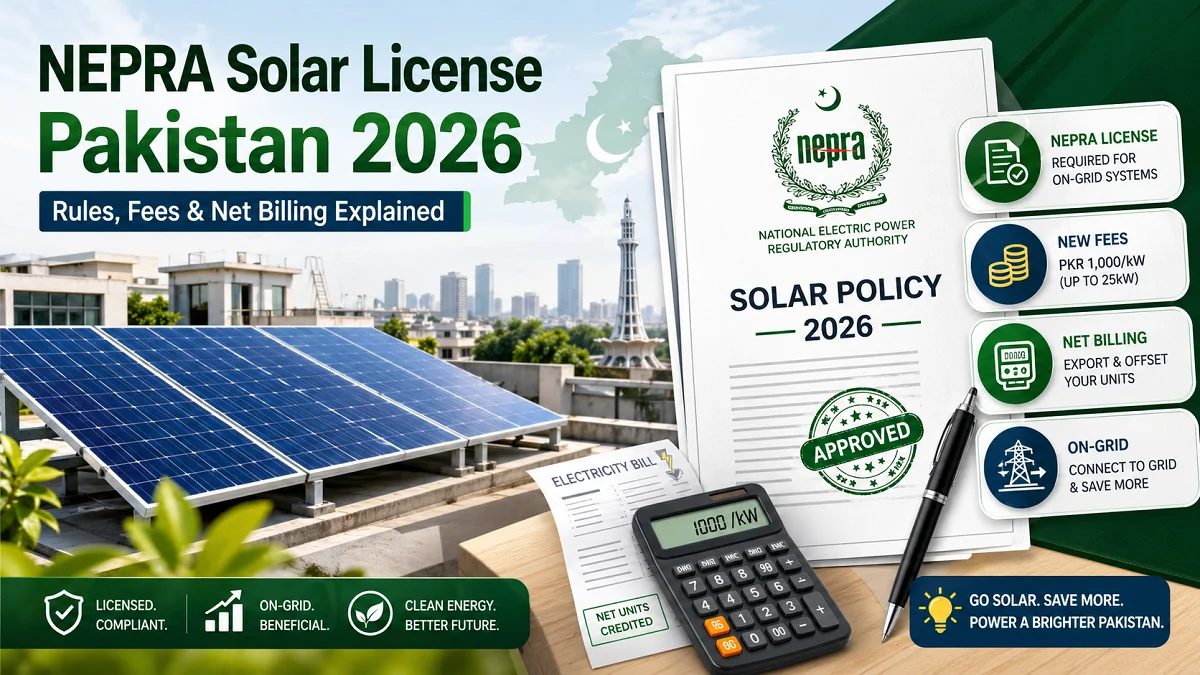
Pakistan’s solar energy market has grown rapidly because electricity bills are high, load shedding still affects many areas, and households want more control over monthly energy costs. In 2026, many solar users became confused after reports claimed that NEPRA solar license Pakistan rules now require every solar user to obtain a license and pay a fee.
The situation needs careful explanation. The key point is that NEPRA has not announced a general solar tax on every solar user. The main issue is related to on-grid solar systems, net billing, and regulatory concurrence. According to recent clarifications, off-grid solar users do not need NEPRA approval, while on-grid solar net billing users are linked with a one-time fee of Rs1,000 per kW under the prosumer framework.
What Has Changed in the Latest NEPRA Regulations?
The major change is not that solar panels are banned or every rooftop panel is being taxed. The real change is that the solar approval framework has become more formal under the NEPRA Prosumer Regulations 2026.

Previously, many small net metering applications were processed through DISCOs under the older net metering structure. Consumers often focused mainly on solar panels, inverters, net metering meters, and DISCO application requirements. Many users also believed that exported solar units would be adjusted in a near unit-to-unit style against imported units.
Under the newer framework, the focus has shifted toward net billing. NEPRA’s regulations describe a structure where electricity imported from the grid is billed at the applicable tariff, while electricity exported by the prosumer is credited at the national average energy purchase price.
The important changes include:
- Net billing has become the key framework for new prosumer arrangements.
- On-grid solar approval is connected with NEPRA concurrence.
- A one-time fee of Rs1,000 per kW applies under the concurrence process.
- Exported units are treated differently from imported grid units.
- Off-grid users are not in the same approval category as grid-connected users.
- Existing agreements may be treated differently from new applications, depending on their validity and terms.
Who Must Apply for a NEPRA Solar License or Approval?
The requirement mainly concerns consumers who want to install a grid-connected solar system and sell or export extra electricity to the distribution network.
This includes many:
- Residential on-grid solar users
- Commercial solar users
- Industrial consumers installing rooftop solar
- Agricultural consumers applying for grid-connected solar
- Institutions such as schools, clinics, offices, and warehouses
- New applicants applying under net billing/prosumer regulations
NEPRA’s prosumer framework refers to consumers who connect a distributed generation facility with the distribution system and participate in the billing arrangement. It also mentions applicant categories such as domestic, commercial, industrial, agricultural, general services, and single-point bulk supply consumers.
Important Point for Small Residential Users
Small residential users should not assume that system size alone decides everything. The approval position depends on whether the user has connected the system to the grid and whether the user is applying under the regulated prosumer or net-billing setup.
A 5kW on-grid system and a 5kW off-grid battery system may both use solar panels, but regulators do not treat them the same.
Updated Fee Structure for Solar System Licensing
One of the most discussed points is the Rs1,000 per kW fee. NEPRA’s prosumer regulations state that applicants must submit a one-time fee of Rs1,000 per kilowatt with the application, payable in favour of NEPRA or as the authority may notify from time to time.
NEPRA Solar License Fee Calculation Table
| Solar System Size | NEPRA Solar License Fee Rate | Estimated One-Time Fee |
|---|---|---|
| 5 kW | Rs1,000/kW | Rs5,000 |
| 10 kW | Rs1,000/kW | Rs10,000 |
| 20 kW | Rs1,000/kW | Rs20,000 |
| 25 kW | Rs1,000/kW | Rs25,000 |
| 50 kW | Rs1,000/kW | Rs50,000 |
Consumers should understand this NEPRA solar license fee as a one-time regulatory fee, not as the total cost of getting solar connected. They may still need to account for the net billing meter cost, installation cost, protection equipment, documentation, testing, wiring, earthing, and installer service charges.
Comparison of Old vs New Licensing Costs
The older system was generally seen as easier for small solar users, especially because many consumers believed small systems up to certain limits were processed without a separate NEPRA fee burden. Under the newer prosumer framework, the Rs1,000/kW fee has become an important cost to include in solar planning.
| System Size | Earlier Common Understanding | New 2026 Fee Position |
|---|---|---|
| 5 kW | Often treated as no separate NEPRA fee for small users | Rs5,000 |
| 10 kW | Usually processed through DISCO net metering flow | Rs10,000 |
| 20 kW | Approval required, but many users focused on DISCO process | Rs20,000 |
| 25 kW | Small-to-medium system category | Rs25,000 |
| 50 kW | Larger commercial/institutional planning needed | Rs50,000 |
The NEPRA solar license fee itself may not be the biggest cost in a solar project, but it matters because solar buyers now need more careful documentation, approval planning, and financial calculation.
Step-by-Step Process to Obtain a NEPRA Solar Licence or Approval
The exact process to obtain a NEPRA solar license can vary depending on the DISCO, system size, and consumer category. However, a grid-connected solar user will usually follow a process similar to this.
Step 1: Review Your Electricity Bill and Sanctioned Load
Before selecting solar panels, check your sanctioned load. NEPRA’s prosumer framework links the distributed generation facility with the consumer’s premises and interconnection conditions. In practical terms, if your sanctioned load is too low, your desired solar system size may create approval problems.
For example, a consumer planning a 10kW on-grid solar system should first check whether the sanctioned load supports that size.
Step 2: Decide Whether You Need On-Grid, Off-Grid, or Hybrid Solar
Do not choose the system only because the installer says it is popular. The system type affects approval, cost, backup, and payback.
| System Type | Grid Export | Battery Backup | NEPRA Approval Concern | Best For |
|---|---|---|---|---|
| On-grid | Yes | Usually no | Yes, if applying under net billing | Homes and businesses with strong daytime usage |
| Off-grid | No | Yes | Generally no NEPRA approval | Remote areas and backup-focused users |
| Hybrid | Sometimes | Yes | Depends on grid export/net billing | Users needing both savings and backup |
A hybrid system can be confusing because some hybrid systems are connected to the grid while others are designed mainly for self-consumption and backup. The approval issue depends on the actual grid interconnection and export setup.
Step 3: Select the Right Solar Capacity
A correct system size should be based on:
- Monthly electricity units
- Daytime usage
- Nighttime usage
- AC load
- Motor or machinery load
- Sanctioned load
- Rooftop space
- Export expectations
- Budget
- Battery requirement
Many buyers make the mistake of installing a bigger system only to export extra units. Under net billing, direct self-consumption may be more valuable than unnecessary export.
Step 4: Prepare Technical Documents
A professional installer should prepare the required documents. These may include:
- CNIC and electricity bill details
- Site address
- Proposed system capacity
- Inverter specifications
- Solar panel specifications
- Single-line diagram
- Protection equipment details
- Earthing and safety details
- Load details
- Application forms
- Fee payment proof
The application form and regulatory documents include details about the applicant, distribution company, generation facility, and approximate monthly energy to be supplied.
Step 5: Submit Application Through the Relevant DISCO
Most consumers deal practically with their electricity distribution company, such as LESCO, IESCO, MEPCO, FESCO, GEPCO, PESCO, HESCO, SEPCO, QESCO, or K-Electric. The DISCO handles the practical connection and implementation side, while NEPRA remains the regulator.
Step 6: Pay the One-Time Fee
The one-time NEPRA solar license fee is calculated at Rs1,000 per kW. Keep proof of payment because it may be required during application processing.
Step 7: Complete Inspection, Metering, and Commissioning
The system must be checked for technical and safety compliance. The metering setup must measure electricity flow properly. Poor wiring, weak earthing, missing breakers, or non-compliant equipment can delay approval and create safety risks.
Understanding Net Billing Under the New Policy
Net billing is one of the most important parts of the new solar discussion in Pakistan. Many older articles and marketing messages still explain solar through the older net metering mindset, where users expected a simple unit-to-unit adjustment.
Under net billing, the bill is calculated differently. NEPRA’s regulations state that electricity supplied by the licensee to the prosumer is billed according to the applicable tariff, while electricity supplied by the prosumer to the licensee is billed according to the national average energy purchase price.
Also read: How to Apply for Net Metering in Pakistan: New Rules 2026
Simple Example of Net Billing
Suppose your home imports electricity from the grid at night and exports extra solar electricity during the day.
Under old-style thinking, many users expected exported units to cancel imported units almost equally. Under net billing, imported units and exported units are valued differently.
That means:
- The electricity you use directly from solar during the day gives strong savings.
- The electricity you export may be credited at a lower rate than the retail tariff.
- A system designed only for maximum export may not give the expected payback.
- A system designed for self-consumption may perform better financially.
Exemption for Off-Grid and Non-Export Solar Users
One of the biggest missing points in many discussions is the position of off-grid users. Off-grid solar systems are not connected to the national grid for exporting electricity. These systems usually use batteries and are common in villages, farms, remote houses, tube wells, and areas where grid supply is unreliable.
Recent clarifications indicate that off-grid solar users do not require NEPRA approval in the same way as grid-connected net billing users.
Examples of Users Who May Not Need NEPRA Approval
| User Type | Likely Approval Position |
|---|---|
| Farm using solar pump without grid export | Usually outside net billing approval |
| House using solar panels with batteries only | Usually treated as off-grid/self-use |
| Remote cabin or rural home without DISCO connection | No grid export approval issue |
| Backup solar system not exporting to grid | Different from on-grid prosumer system |
However, exemption from NEPRA approval does not mean exemption from safety. Off-grid systems still need proper installation, battery protection, earthing, and quality equipment.
Impact on Existing Solar Consumers Across Pakistan
Existing solar users are concerned about whether they must pay the new fee again or whether their old net metering agreement will be cancelled. This is a very important question.
Reports on NEPRA’s revised rules indicate that authorities protect existing valid approvals and agreements under the earlier framework, while they place new applicants under the updated regulations. Existing net metering arrangements may continue until their agreement terms expire, but major modifications or expansions may affect that status.
What Existing Solar Users Should Do
Existing users should:
- Keep their net metering agreement safe.
- Check the expiry date of their agreement.
- Avoid increasing system capacity without confirming the rules.
- Contact the relevant DISCO before making major changes.
- Keep old approval letters, meter documents, and commissioning records.
- Ask whether expansion will shift them to the new framework.
If you already have a valid net metering system, do not panic based on social media posts. First verify your agreement status and DISCO record.
Impact on New Solar Buyers in Pakistan
New buyers need to be more careful than before. The solar market is still attractive, but the calculation has changed.
For Home Users
A 5kW or 10kW home system may still make sense, especially if the family uses ACs, fans, washing machines, water pumps, and appliances during the day. However, buyers should not rely only on exported units for savings.
For Commercial Users
Commercial users often have strong daytime consumption, so solar can still be very useful. Shops, offices, schools, clinics, warehouses, and factories may benefit because they use electricity when solar production is high.
For Agricultural Users
Solar can help tube wells and farms, but the choice between off-grid pumping, hybrid backup, and grid-connected net billing should be made carefully.
For Industrial Users
Industrial users should calculate solar feasibility using load profile, sanctioned load, transformer capacity, peak demand, power factor, backup requirement, and approval timeline.
Government Objective Behind These Changes
The government and regulator appear to be moving toward a more controlled and documented solar market. Pakistan’s rooftop solar adoption has increased quickly, and unplanned grid export can create technical and financial challenges for DISCOs.
The likely objectives include:
- Improving grid stability
- Standardizing solar approvals
- Managing exported electricity more clearly
- Keeping records of grid-connected solar capacity
- Ensuring technical safety
- Shifting from old net metering to net billing
- Reducing confusion in electricity billing
- Bringing large and small prosumers under a formal framework
For consumers, this means solar is still allowed, but grid-connected solar is becoming more regulated.
Challenges and Concerns for the Public
The new framework has created several genuine concerns.
Higher Upfront Cost
The Rs1,000/kW fee is not very large compared with the total cost of solar, but it still raises the upfront amount. For a middle-class household that is already arranging money for panels, the inverter, the mounting structure, wiring, and meter charges, every additional cost matters.
More Paperwork
Consumers now need to pay closer attention to application documents, technical specifications, sanctioned load, and DISCO processing.
Confusion Between Tax and Fee
Many people still believe this is a new solar tax. That confusion can discourage buyers unnecessarily.
Reduced Export Benefit
Net billing changes the financial logic. Buyers who expected strong returns from exporting large surplus units may need to recalculate.
Risk of Misleading Installer Claims
Some installers may still sell systems using old net metering promises. Buyers should ask for calculations based on the current net billing framework.
Opportunities for Solar Growth Despite New Rules
Despite the confusion, solar still has strong potential in Pakistan. Electricity tariffs remain high, and many consumers want relief from expensive bills.
Solar can still help when the system is designed correctly.
Why Solar Still Makes Sense
- Daytime self-consumption can reduce grid purchases.
- Commercial users often consume power during solar production hours.
- Hybrid systems can help during load shedding.
- Off-grid solar remains useful in remote areas.
- High-quality systems can provide long-term savings.
- Rising energy costs make efficiency more valuable.
The key is not to avoid solar. The key is to plan solar with the right expectations.
Common Mistakes People Make Under the New NEPRA Solar Rules
Thinking Every Solar User Must Pay
Not every solar user is in the same category. Off-grid users and grid-connected net billing users are different.
Calling the Fee a Solar Panel Tax
The Rs1,000/kW amount is better understood as a one-time concurrence or approval fee for grid-connected prosumer arrangements, not a general tax on every solar panel.
Ignoring Sanctioned Load
A buyer may want a 15kW system, but the sanctioned load may not support it. This can create approval delays.
Oversizing the System for Export
A large system may not be ideal if most electricity is exported at a lower credit rate. Self-consumption matters more.
Buying Solar Without Reading the Bill
The last 12 months of bills show seasonal consumption. Without this data, system sizing becomes guesswork.
Trusting the Cheapest Installer
Low-cost installations often cut corners on breakers, earthing, cables, structure, and surge protection. These shortcuts can become dangerous and expensive.
Also read: Solar Inverter Price in Pakistan 2026: The Ultimate Guide
Key Takeaways for Solar System Buyers in 2026
| Factor | What You Should Know |
|---|---|
| NEPRA solar license Pakistan | Mainly relevant for grid-connected net billing users |
| Fee | Rs1,000 per kW as a one-time concurrence fee |
| Off-grid solar | Generally does not need NEPRA approval |
| Net billing | Exported units are credited differently from imported units |
| Existing users | Should check agreement status before changing capacity |
| New buyers | Must calculate savings under current rules |
| Best system size | Depends on daytime usage, sanctioned load, and budget |
| Biggest risk | Misunderstanding old net metering vs new net billing |
Quick Summary (NEPRA Solar License Fee)
The NEPRA solar license Pakistan issue is mostly about on-grid solar and net billing, not a blanket restriction on every solar user. New grid-connected solar applicants should expect a formal approval process and a one-time Rs1,000/kW fee. Off-grid users are generally not required to obtain NEPRA approval, but they should still follow safe installation practices.
For Pakistani buyers, solar remains useful, but the decision must be based on accurate billing assumptions, proper system sizing, and current regulations.
Also read: Types of New Solar Systems – Which One is Best?
Final Advice for Pakistani Solar Users
If we are planning to install solar in 2026, we should not rely only on viral posts, installer claims, or old net metering calculations. We should first identify whether the system is on-grid, off-grid, or hybrid. Then we should check sanctioned load, daytime usage, expected export, DISCO requirements, and total project cost.
Solar is still a practical solution for many Pakistani homes and businesses, but the best results will come from careful planning. Under the newer framework, the smartest solar system is not always the biggest system. It is the system that matches our real usage, approval position, and long-term savings.
Also read: Top 10 Solar Panels in Pakistan: The Ultimate Guide 2026
FAQs About NEPRA Solar License Pakistan
1. Is NEPRA solar license mandatory for all users in Pakistan?
No, it should not be understood as a blanket rule for every solar user. The approval requirement mainly concerns on-grid solar users applying under the net billing/prosumer framework.
2. What is the NEPRA solar license fee in 2026?
The one-time fee is Rs1,000 per kW for relevant on-grid solar concurrence. For example, a 10kW system would require Rs10,000 as the fee.
3. Is the NEPRA solar fee a new tax?
No, it is better described as a one-time regulatory fee for grid-connected solar approval, not a general tax on all solar panels.
4. Do off-grid solar users need NEPRA approval?
Generally, off-grid users who do not export electricity to the grid are not treated like net billing prosumers and do not need NEPRA approval under the same arrangement.
5. What is the difference between net metering and net billing?
Net metering was commonly understood as a stronger unit-to-unit adjustment. Net billing separates imported and exported electricity: imported power is charged at the applicable tariff, while exported power is credited at the national average energy purchase price.
6. Do existing net metering users need to apply again?
Existing users should check their agreement and DISCO record. Reports indicate that valid existing arrangements may continue under their earlier terms, but major changes or expansions may affect the status.
7. Should we install solar in Pakistan after the new NEPRA rules?
Yes, solar can still be worthwhile, especially where daytime electricity use is high. However, buyers should calculate savings under net billing instead of relying on old net metering assumptions.
8. Which system is better in 2026: on-grid, off-grid, or hybrid?
On-grid is suitable for users with strong daytime usage and grid access. Off-grid is better for remote areas or full backup needs. Hybrid is useful when users want both bill savings and backup, but approval depends on whether the system exports to the grid.
9. What should we check before applying for on-grid solar?
Check your sanctioned load, connection type, last 12 months of bills, system capacity, inverter specifications, protection equipment, DISCO process, and fee requirement.
10. Can the NEPRA solar license fee increase in the future?
The regulations mention Rs1,000/kW or as may be notified from time to time, so consumers should verify the latest official NEPRA solar license fee or DISCO sources before applying.
Also read: Top Solar Batteries in Pakistan – Guide to Choose the Best