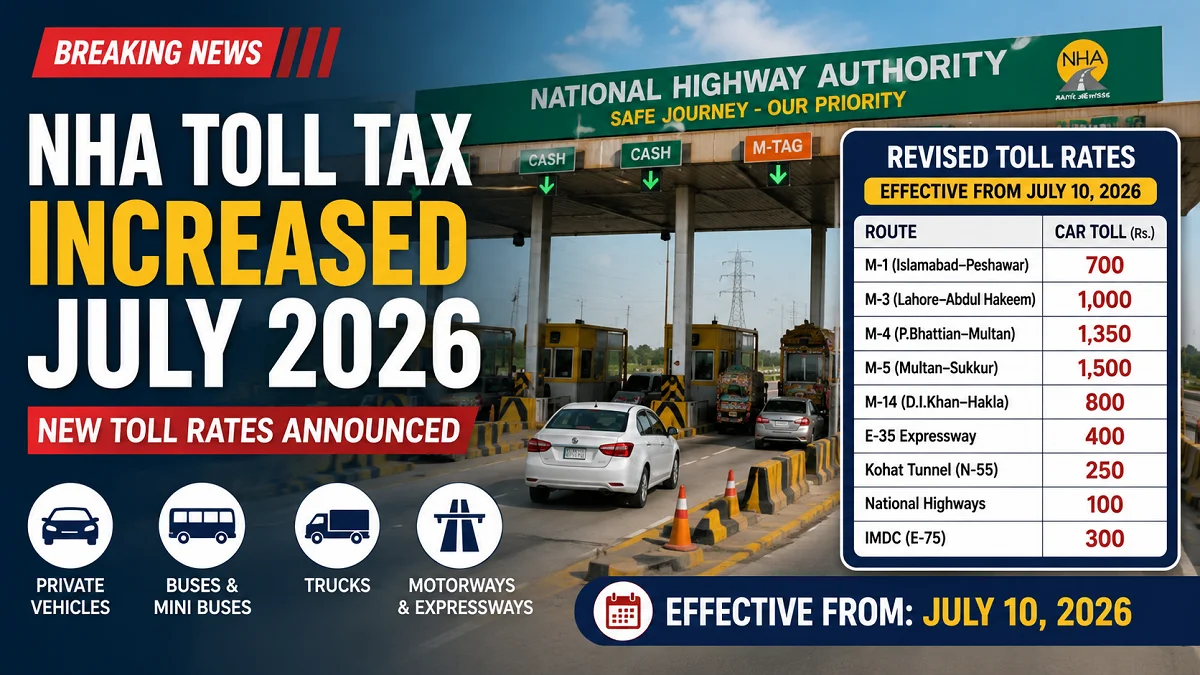
The NHA Toll Tax Increased July 2026 notification has officially come into effect, bringing revised toll charges for motorists using Pakistan’s major motorways, national highways, and expressways. The new rates are effective from July 10, 2026, and apply to private vehicles, passenger transport, and commercial trucks.
The increase affects several important routes, including the M-1, M-3, M-4, M-5, M-14, E-35 Expressway, Kohat Tunnel (N-55), and Islamabad-Murree Dual Carriageway (E-75). Drivers who regularly travel between cities should be aware of the updated toll charges before planning their journeys.
According to the latest notification issued by the NHA Finance Wing (Revenue Directorate), the revised toll rates are now applicable across several important transport corridors.
Which Roads Are Affected?
The revised toll charges apply to the following routes:
These roads carry thousands of commuters and commercial vehicles every day, making the revised toll schedule important for both individual travelers and transport companies.
The revised toll schedule means higher travel costs for:
Daily commuters using motorways
Families travelling during weekends or holidays
Passenger transport operators
Logistics companies
Heavy commercial transport businesses
Although the increase may raise transportation expenses, the NHA says toll revenue is essential for maintaining Pakistan’s expanding motorway network and ensuring safer road travel.
How Drivers Can Reduce Travel Costs
Motorists cannot avoid paying tolls on designated NHA roads, but they can manage travel expenses by following these practical tips:
Plan Longer Trips Carefully
If making multiple city visits, combine them into one journey where possible to reduce repeated toll payments.
Use Electronic Toll Payment if Available
Where electronic payment systems are available, they can help speed up travel through toll plazas and reduce waiting time.
Share Travel Costs
Families and colleagues travelling together can split fuel and toll expenses.
Check Your Route Before Departure
Compare different travel routes to determine whether using a motorway offers enough time savings compared to alternative roads.
Commercial Transport Planning
Transport companies should update delivery budgets and freight charges to account for the revised toll schedule.
Frequently Asked Questions (FAQs)
When did the new NHA toll tax rates become effective?
The revised toll tax rates became effective on July 10, 2026.
Which motorways have new toll charges?
The revised rates apply to M-1, M-3, M-4, M-5, M-14, E-35 Expressway, Kohat Tunnel (N-55), National Highways, and the Islamabad-Murree Dual Carriageway (E-75).
Has the toll increased for private cars?
Yes. Private cars travelling on the affected motorways and expressways must now pay the updated toll charges according to the route they use.
Which motorway has the highest car toll?
Among the listed routes, the Multan–Sukkur Motorway (M-5) has the highest toll for cars at Rs.1,500.
Are commercial trucks included in the revised rates?
Yes. The notification includes updated charges for 2 & 3 axle trucks as well as articulated trucks.
Do the new rates apply across Pakistan?
The revised rates apply only to the specified NHA-managed highways, motorways, and expressways mentioned in the official notification.
Final Thoughts (NHA Toll Tax)
The latest NHA Toll Tax Increased July 2026 notification introduces higher toll charges across several of Pakistan’s busiest highways and motorways. Whether you are a daily commuter, an occasional traveler, or a transport operator, it is important to know the updated rates before beginning your journey.
As Pakistan continues to expand and maintain its motorway infrastructure, motorists should expect periodic revisions to toll charges. Staying informed about these updates can help travelers budget more accurately and avoid surprises during long-distance trips.